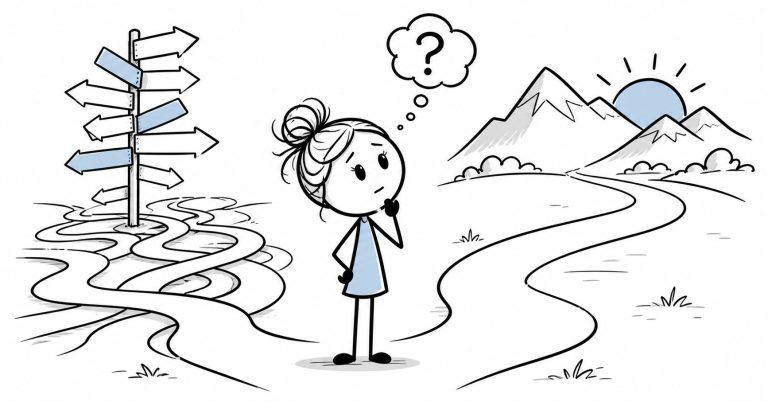

Most people approach regret-proofing a decision the wrong way.
They try to eliminate the possibility of a bad outcome.
More research. More time. More opinions. One more podcast. One more conversation with a friend who is also confused but speaks with confidence. More certainty accumulated before committing. If they can just see far enough ahead, they reason, they can rule out the versions of the future that end in disappointment.
The problem is that the future is not available for preview.
You cannot research your way into certainty about how a decision will turn out. You cannot think long enough or carefully enough to guarantee the outcome. And the longer you try, the more you compound the one regret that rarely gets counted.
The regret of not deciding.
Regret-proofing is not about choosing perfectly.
It is about choosing honestly.
Those are not the same thing. And the distinction changes everything about how you make the decision.
The Two Kinds of Regret
Before you can make a decision you will not regret, you need to understand what regret actually is and where it comes from.
Most people think of regret as the feeling that follows a bad outcome. You chose something, it did not work out the way you hoped, and now you wish you had chosen differently.
That is one kind of regret. Call it outcome regret.
But there is a second kind that is quieter, slower, and in many cases more damaging.
The regret of not choosing at all.
The direction you circled for years but never committed to. The version of your life you kept putting off until the conditions were better. The thing you always knew you wanted to try, and never did, and now carry as a permanent open question.
That kind of regret does not arrive dramatically. It accumulates. And it is uniquely hard to address because there is no clear moment when the decision was made. It just slowly became the choice by default.
Here is what matters about these two types.
Outcome regret is survivable and instructive. You made a real move, it did not go as planned, and you learned something true about yourself and your situation in the process. That information has value. You are not back at zero. You are further along than the person who never moved.
The regret of not choosing accumulates compound interest. Every year the question stays open, the cost grows. The window narrows. The other things you could have built in the time you spent circling become visible in hindsight.
Most people spend their energy trying to avoid outcome regret.
Most people’s actual regret comes from the other kind.
Why Trying to Choose Perfectly Produces More Regret
There is a cruel irony in decision-making that almost nobody names directly.
The harder you work to avoid a bad outcome, the more likely you are to create the conditions for the regret you are actually trying to avoid.
More time in the research phase is more time not building.
More rounds of deliberation is more distance between you and the first real piece of feedback.
More waiting for certainty is more practice at waiting, which makes the next decision feel equally uncertain, which keeps the waiting going.
The pursuit of the perfect decision is often the mechanism that produces regret.
Not because the decision was wrong.
Because the deciding never ended.
What Honest Choosing Actually Looks Like
Honest choosing is not impulsive.
It is not reckless.
It is not the absence of thought or preparation.
It is making a decision with the information you have, based on what you actually know about yourself and what you actually want, without requiring the outcome to be guaranteed before you commit.
It sounds like:
I know enough about this direction to take the next real step. I know what I value. I know where this fits in my life. I cannot know how it will turn out, and I am choosing it anyway because the honest answer to the question of what I want to do is this.
That is a different internal experience than:
I have researched this enough that if it goes wrong I can say I did everything right. I am covering myself. I am making the defensible choice rather than the real one.
The first version is honest choosing.
The second version is choosing for an audience, even when that audience is just your future self looking for someone to blame.
This is why people stay in the job they can explain instead of pursuing the direction they keep thinking about in the shower. The safe choice has a better public relations department. That does not make it the right choice.
Honest choosing puts your actual values and your actual judgment on the line.
That is exactly why it feels more vulnerable.
And exactly why it produces less regret.
The Question That Cuts Through
When a decision feels impossible to make cleanly, one question cuts through faster than any pros and cons list.
What would I choose if I were not afraid of looking foolish?
Not what would I choose if I had more information. Not what would I choose if I could guarantee the outcome. Not what would I choose if everyone around me would understand and approve.
What would I choose if the only audience was my own honest judgment?
That answer is almost always available.
It is usually the thing you already know, dressed in the discomfort of being accountable for it.
Write it down. Before you add qualifiers. Before you explain why it is complicated. Before you start building the case for why it might be wrong.
Just the answer.
That is the decision.
What Regret Actually Comes From
The research on regret is worth knowing here.
People consistently report that the actions they regret most are not the ones that failed. They are the ones they never took.
Not the wrong choice. The unchosen choice.
Not the business that did not work. The business they never started.
Not the relationship that ended. The relationship they never pursued because the timing was not perfect.
Not the career change that required adjustment. The career change they spent a decade considering and never made.
This pattern is consistent. Short-term, people regret actions that did not work out. Long-term, people regret inactions far more.
You are not trying to avoid a bad outcome.
You are trying to avoid building a life full of the quiet, chronic weight of things you never gave a real answer.
That weight is heavier than most wrong decisions.
The Framework That Reduces Regret
Not eliminates. Reduces.
Three questions, asked honestly, before you commit.
Is this actually mine to choose?
Not is it a good opportunity. Not is it a smart move. Is this decision yours to make based on your actual values, your actual direction, and what you actually want from this season of your life?
If the answer is yes, the regret risk drops significantly. Decisions that are genuinely yours, made on your own terms, tend to produce far less regret even when the outcome is imperfect. Because you made them honestly.
If the answer is no, or if the honest answer is that you are choosing this because it feels safe or because someone else thinks you should, the regret risk climbs. Decisions made for the wrong reasons tend to produce regret regardless of the outcome.
Have I done enough thinking or am I using thinking to avoid choosing?
There is a version of deliberation that is genuinely useful. You gather information, you examine the decision from multiple angles, you identify your actual priorities, and then you choose.
And there is a version that is delay with a responsible disguise.
You know which one you are in.
The honest answer to this question usually takes about thirty seconds to surface. Trust what surfaces.
Am I making the defensible choice or the honest one?
The defensible choice is the one you can explain to others if it goes wrong. The one that follows the expected logic. The one that will not require you to defend your reasoning.
The honest choice is the one that reflects what you actually want, what actually fits, and what you would choose if the only person you had to account to was your own judgment.
The defensible choice protects you from criticism.
The honest choice protects you from regret.
When they are the same choice, decide with confidence.
When they are different choices, the honest one will almost always produce less regret. Even if it is harder to explain.
The Specific Regret Worth Avoiding
Not the regret of being wrong.
Being wrong is survivable. It is informative. It is a chapter you can write your way through.
The regret worth avoiding is the permanent open question.
The decision that never got a real answer because the timing was never quite right, the confidence was never quite there, the certainty was always one more round of research away.
Make the decision.
Not perfectly. Honestly.
Give yourself a real answer while you still have real choices in front of you.
That is the only regret-proofing that actually works.
If the Pattern of Avoiding Decisions Is Running Your Life
If avoiding regret has quietly turned into avoiding decisions, the real issue is probably not the decision in front of you.
It is the pattern underneath it.
Research loop.
Self-trust gap.
Comparison spiral.
Fear of choosing the thing you cannot easily explain.
The Why You’re Still Stuck quiz gives you a clearer read on what is actually keeping you from the decisions you already know you need to make.
Seven questions.
Take it before the open question gets another year older.