I want to skip the part where I tell you overthinking is bad and you should just trust yourself.
You’ve heard that.
It didn’t work, or you wouldn’t still be circling this.
Here’s what I actually hear, over and over, from people stuck in this exact spot:
“I don’t want to make the wrong decision.”
“I just need to make sure.”
“I keep researching.”
“I asked a few people what they think.”
“I’m afraid I’ll regret it.”
“I want the best outcome, not just an okay one.”
“I’m still looking for the safe option.”
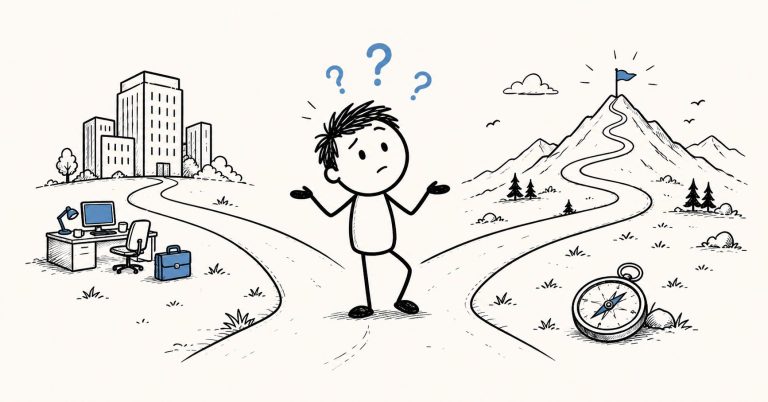
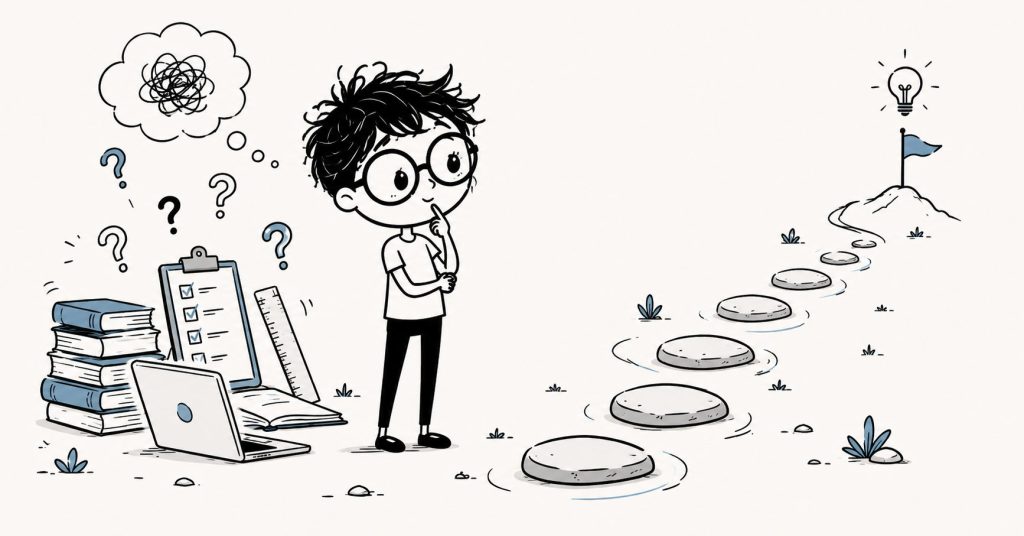
This is Analysis Paralysis Alex territory.
Alex does not lack information. Alex has information in 4 folders, 3 browser windows, a color-coded spreadsheet, and probably the opinions of 7 trusted people.
Some of you have polled your group chat, read 40 reviews, and ended up more confused than when you started, because now you have 6 conflicting opinions instead of 1 undecided thought.
Congratulations, you’ve achieved research.
You have not achieved a decision.
I’m not going to tell you research is the enemy.
Research is real and useful and sometimes the responsible thing to do.
The problem is nobody ever taught you how to tell the difference between researching because you need an answer and researching because you’re scared of the one you already have.
Both feel almost identical from the inside.
That’s the whole trap.
Fear does not show up wearing a sign.
It shows up wearing a library card.
There is a real difference between useful waiting and fear-based waiting, and it’s simpler than you think.
Useful waiting has an end date and a specific question attached to it.
Fear-based waiting keeps asking for more certainty with no clear line where it stops.
If you cannot tell me when your research ends or what would satisfy it, there is a good chance information is no longer the real problem.
So here is the actual test.
Not “trust yourself more,” because that is advice with no instructions attached.
This is the instructions.
1. Name the missing information. Specifically.
Not:
“I need to look into it more.”
That is not information.
That is a feeling wearing a task list.
What, exactly, do you still need to know?
Write the actual question.
“I need to know if this program is accredited.”
“I need to know what this actually costs after the intro rate.”
“I need to know if she is even available that week.”
Something you could hand to another person and they would know exactly what to go find out.
If you cannot name the missing information, stop assuming more research is automatically the answer.
You may have moved from an information problem into a decision problem.
2. Ask whether the answer could actually change your decision.
This is the question almost nobody asks, and it matters more than most of the research itself.
Take your specific question from Step 1.
If you got the answer today, would it change what you do?
Yes or no.
If yes, go get it.
That is real research.
I’ll wait right here while you do it.
If no, be honest.
If the answer would not move you either way, then the research probably stopped being useful about 3 Google searches ago.
You are no longer gathering information.
You may be auditioning for the role of Someone Who Did Everything Right, in case it goes wrong later and you need an alibi.
If part of the problem is that you have several directions competing for your attention, read How Do I Know Which Idea I Should Actually Pursue?. That exercise helps you narrow the options before you start researching each one to death.
3. Name what you are actually afraid of.
Finish this sentence:
What I’m really afraid will happen if I choose is ________.
Not the polite version.
The real one.
“I’ll waste the money.”
“I’ll look foolish for changing direction again.”
“I’ll pick this and find out I’m not actually good at it.”
That last one is often closer to the center than people want to admit.
Most people are not only afraid of the wrong choice.
They are afraid of finding out something true about themselves that they cannot take back.
This is where more Googling stops helping.
Ask yourself 3 things:
Heart: What do I actually want here?
Mind: What does the evidence already tell me?
Fear: What am I afraid this decision will prove about me?
Those are 3 different questions.
When you keep treating all 3 like an information problem, you can research for months and still feel stuck.
If you are the praying type, there is another useful question:
Can I hand this to God and be okay if the answer is no?
If yes, you may be closer to ready than you think.
If that question makes your stomach drop, pay attention to that too.
4. Give the research an ending. An actual one.
If you got through Step 2 and the answer genuinely could change things, good.
Now decide, in writing, 3 things:
What exactly do I still need to find out?
Where am I going to get that information?
By when?
A date.
Not “soon.”
Soon is where decisions go to retire.
If the answer would not change the decision, then the research is done whether you feel done or not.
Feeling done was never going to happen on its own.
Comfort is not a finish line.
It is a mood.
And moods do not show up on command.
Otherwise, you end up like Alex.
She has the spreadsheet.
The journal.
The opinions.
The bookmarks.
The screenshots.
Every answer opens 3 more questions, and the door stays open because an open door feels safer than risking the wrong room.
Alex is not confused.
She is thorough in a way that is sometimes just fear with excellent organizational skills.
I say that with love.
I have been Alex.
Possibly still am on a bad week.
Here is the part I want you to remember.
Not deciding is not neutral.
You do not avoid the risk of choosing wrong by refusing to choose.
You trade it for a quieter risk: letting time, circumstances, or somebody else make the decision while you are still “looking into it.”
That risk does not announce itself.
Which is why people can sit in it for years.
Name the gap.
Check whether the answer would actually move you.
If it would not, name the fear underneath it.
Give the research an end date.
Then close the tab.
You cannot solve what you have not named.
Why You’re Still Stuck (It’s Not What You Think)
7 questions. Uncomfortably accurate. This is not a personality quiz. It is a diagnosis.
TAKE THE QUIZ →