Some decisions are genuinely hard.
Leaving a marriage. Ending a business. Walking away from a career you spent a decade building. Moving across the country with no safety net.
Those are hard decisions. They deserve serious thought, real time, and a few honest conversations with people who know you well.
But that is not the decision you are currently overthinking.
The decision you are currently overthinking is whether to apply for the job you already know you want. Whether to enroll in the program you have been circling for eight months. Whether to finally launch the thing you have been quietly building in the margins of your actual life. Whether to say yes to the direction that keeps returning every time you get quiet enough to hear yourself think.
That decision is not actually hard.
You have made it hard. There is a difference.
And there is a reason you keep doing it.
What Overthinking Actually Is
Most people treat overthinking like a thinking problem.
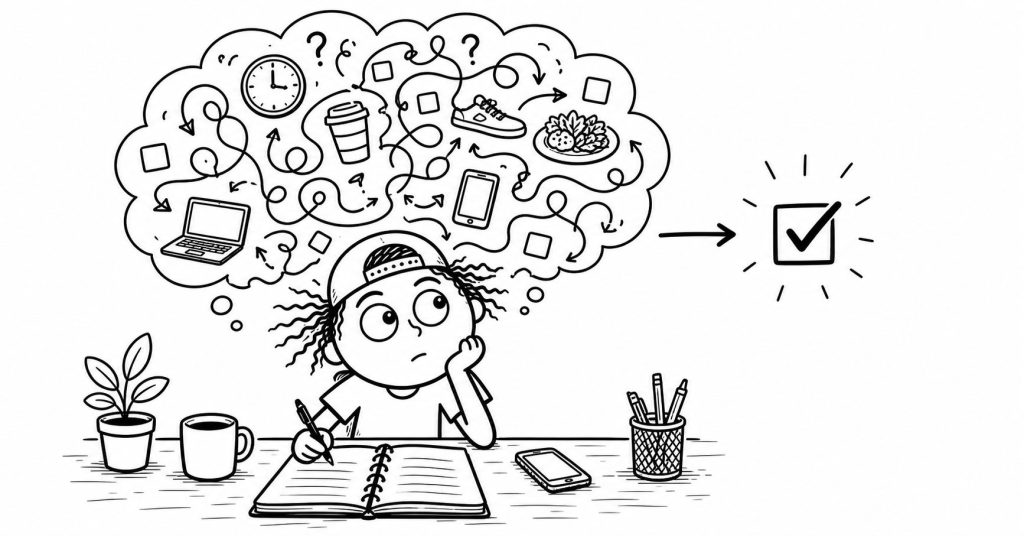
Too many thoughts. Too many angles. Too much information. Too many possible outcomes running around your head like unsupervised toddlers with markers.
So the obvious solution seems to be better thinking. More organized thinking. A cleaner pros and cons list. Maybe a new notebook, because apparently the first twelve were just warm-ups.
But overthinking is usually not about needing better thoughts.
Overthinking is what happens when your brain creates friction to protect you from the discomfort of committing.
The thoughts are not the main problem. The number of thoughts is the symptom.
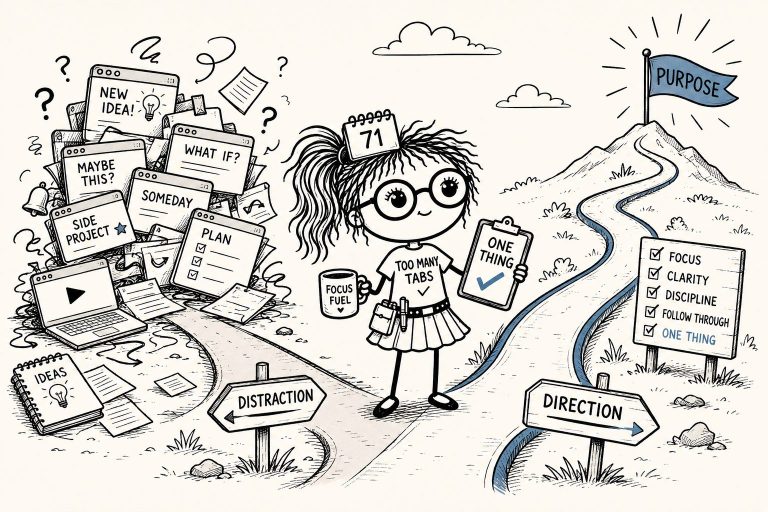
The real issue is that commitment suddenly looks dangerous, so your brain opens 71 tabs worth of questions, concerns, scenarios, and fake emergencies to slow you down before you do something real.
Your brain is not confused.
Your brain is cautious.
A confused brain needs more information. A cautious brain needs a reason to trust that moving forward is safe.
Those are two different problems. Most overthinking advice gives you tools for the first one when you are actually dealing with the second.
More lists will not fix caution.
More analysis will not fix fear.
More research will not produce the certainty you are waiting for before you commit.
You need to recognize what is actually happening, name it clearly, and stop letting your fear run the meeting while wearing glasses and pretending to be wisdom.
The Three Things Overthinking Is Protecting You From
When a decision is genuinely simple but feels impossibly complicated, your brain is usually trying to protect you from one of three things.
1. Regret
Regret is powerful because it feels real before anything has even happened.
You imagine making the wrong choice. You imagine wishing you had chosen differently. You imagine Future You standing somewhere disappointed, exhausted, and giving Present You the side-eye.
Your brain takes that imagined regret seriously. So seriously that it may convince you the safest move is no move at all.
But here is the part your brain conveniently leaves out: not deciding has consequences too.
There is also regret in staying stuck.
There is regret in watching the same opportunity pass you three different times because you kept calling hesitation “being careful.”
There is regret in realizing you did not avoid a mistake. You avoided movement.
That one arrives slower, but it still shows up.
2. Judgment
Sometimes the decision itself is manageable.
The imagined audience is the problem.
What will people think?
Will they think it is too risky? Too small? Too late? Not practical enough? Not impressive enough? Not the thing they would have chosen?
That question can stop a perfectly reasonable decision cold.
And let’s be honest, half the people you are mentally polling do not have a real stake in your life. Some of them would forget about your decision by Thursday. A few should not have been granted advisory board seats in the first place.
But your brain treats social risk like danger. So now you are not just deciding whether to apply, launch, enroll, move, say yes, say no, or try something new.
You are holding a full committee meeting with people who did not buy a ticket to your life and somehow still got microphones.
That will make anything feel harder than it is.
3. Being Wrong
This is the deepest one.
You are not just afraid the decision might not work.
You are afraid that if it does not work, it will mean something about you.
That your judgment cannot be trusted.
That your instincts are unreliable.
That the thing you thought was a nudge, calling, desire, idea, or next step was actually just you making things up.
So the decision starts to feel like a test.
And if a decision feels like a test, then delaying it feels safer than taking it.
That is how people who are capable, thoughtful, and intelligent end up stuck on decisions that are not actually that complicated.
They are not weighing the decision anymore.
They are trying to avoid the emotional verdict they think the outcome will deliver.
You Are Running Security Screening on a Decision That Does Not Warrant It
None of these fears are irrational.
Regret is real. Judgment can sting. Being wrong is uncomfortable.
But your brain has turned old pain into a standing policy.
Now every decision gets treated like it might ruin everything.
Apply for the job? Security screening.
Start the project? Security screening.
Send the email? Security screening.
Pick the program? Security screening.
Choose the direction that has been tapping on your shoulder for months? Full airport pat-down, suspicious bag check, and three emotional support snacks.
You are running threat-level security on a decision that probably requires a normal amount of caution and one grown-up choice.
That is the problem.
Not the decision.
The security system around the decision.
How to Recognize When You Are Overcomplicating Something
There is a pattern that shows up when a decision is simpler than you are making it.
Once you see it, you cannot unsee it.
You keep returning to the same decision.
Simple decisions get made and forgotten.
Complicated decisions get handled with care.
But if you have been circling the same choice for weeks or months without new information changing anything, you are probably not still deciding.
You are rehearsing the delay.
The decision has not gotten harder. You have gotten more practiced at not making it.
That matters, because practice builds skill.
You may not be getting better at deciding. You may be getting better at postponing.
That is a skill too. Just not one you want to keep sharpening.
The stakes keep getting bigger in your head.
You started with one decision.
Should I apply for this job?
Now somehow you are asking whether this is the right field, whether this is the right time, whether you have what it takes, whether your whole life has been one long detour, and whether God is sending you signs through a podcast title and a suspiciously timed Instagram post.
Calm down, Board of Directors.
The original decision was not that large.
Your brain made it large because large decisions justify more delay.
That spiral is avoidance wearing a blazer and carrying a clipboard.
You are asking everyone except yourself.
You have consulted friends, mentors, podcasts, quizzes, articles, search results, and maybe one person on Facebook whose life looks organized because she owns matching storage bins.
And you still have not decided.
At some point, you are not looking for input.
You are looking for someone else to absorb responsibility for the choice.
You want the voice that says, “Yes, do that,” so if it goes badly, you can tell yourself you were following wise advice.
That is not clarity.
That is outsourcing.
The decision is yours. Annoying, inconvenient, but true.
You know what you would tell a friend.
This is the clearest sign.
If a friend came to you with your exact situation, you would probably know what to say.
Apply.
Send it.
Stop circling.
Take the meeting.
Try it for 90 days.
Tell them no.
Tell them yes.
Pick the option that keeps coming back.
You would not need a three-month research sabbatical to give them a reasonable answer.
The fact that you can see it clearly for someone else but not for yourself tells you something.
You are not dealing with complexity.
You are dealing with self-trust.
You extend reasonable confidence to other people’s judgment while treating your own like it needs adult supervision.
That is the work.
Why Thinking Harder Makes It Worse
Intelligent people can make overthinking look impressive.
That is part of the trap.
Your brain can generate a smart argument for Option A and an equally smart argument for Option B.
Then it can generate concerns about both.
Then it can create a hybrid option that combines the safest parts of each while solving nothing and requiring seventeen more decisions.
Now you have not gained clarity.
You have created a bigger mental spreadsheet.
This is why normal decision-making advice often fails overthinkers.
More frameworks create more variables.
More journaling creates more angles.
More conversations create more opinions to sort through.
You are using the same machinery to solve the problem that created the problem.
At some point, the most intelligent thing you can do is notice when your brain has moved from useful thinking into loop maintenance.
Loop maintenance sounds very smart.
It uses complete sentences.
It references risk management.
It says things like, “I just want to be wise.”
Fine. Be wise.
Then recognize when wisdom has left the room and fear has taken the chair.
What To Do Instead
You do not need to feel magically confident before you move.
You need a process that interrupts the loop.
Here are four concrete moves.
1. Set a decision boundary.
Give yourself a specific date by which you will decide.
Not “soon.”
Not “when I feel peace.”
Not “after I look into it a little more,” which is overthinker code for “see you next fiscal quarter.”
Pick a date.
Write it down.
At that point, you decide with the information you have.
The boundary matters because overthinking thrives in open-ended time. When the timeline is unlimited, the loop can run indefinitely and call itself being thorough.
A decision boundary forces the loop to close.
It also forces you to face the real question: am I actually missing information, or am I delaying because deciding makes this real?
That question will tell on you quickly.
2. Identify the real fear underneath the complexity.
Go back to the three things overthinking protects you from:
Regret.
Judgment.
Being wrong.
Which one is driving this decision?
Do not write, “I’m scared.”
That is too vague. Vague fear grows in the dark and starts redecorating.
Write the actual sentence.
“I am afraid that if this does not work, it will prove I cannot trust my judgment.”
“I am afraid people will think I am foolish for trying this.”
“I am afraid I will regret choosing this and feel trapped.”
That level of honesty matters.
Named fear can be examined.
Vague fear just paces around your brain knocking things over.
3. Ask the one-year question.
Do not ask, “Will I regret this in ten years?”
That is too abstract. Ten-year-you is basically a fictional character wearing better skincare.
Ask this instead:
If I make this choice and it turns out to be wrong, what is my actual situation one year from now?
Walk through it plainly.
Not dramatically. Plainly.
What would happen? What would you lose? What would you still have? What would you know then that you do not know now? What would your next move be?
Most of the time, the realistic answer is far less catastrophic than the version your brain has been screening in IMAX.
You might be disappointed. You might need to adjust. You might need a new plan.
Fine.
That is not the end of your life. That is Tuesday for people who actually do things.
4. Take the smallest real action.
Not a planning action.
Not a research action.
Not a “let me organize my thoughts first” action.
A real action.
Send the email. Submit the application. Make the phone call. Register for the thing. Book the consultation. Ask the question. Have the conversation.
The action does not have to be the full commitment. It just has to exist outside your head.
That is the line.
Inside your head, everything turns into fog, noise, fear, and pretend productivity.
Outside your head, reality gives feedback.
And real feedback, even uncomfortable feedback, is almost always easier to work with than the haunted slideshow your brain creates when it has no real data.
The Specific Lie Overthinking Tells You
Overthinking makes one promise it never keeps.
It promises that if you think about this long enough, you will eventually reach a clean moment of certainty.
The right choice will become obvious. The risk will feel manageable. You will feel ready. The clouds will part. The notebook will glow. A calm voice will say, “Proceed, chosen one.”
No.
That moment is not coming.
Not because you are doing anything wrong.
Because readiness is not produced by more thinking. Readiness is usually produced by deciding and then watching yourself survive the first few steps.
The clarity you are waiting for before you commit is probably on the other side of commitment.
You are standing outside the wrong door, knocking like clarity is going to answer in a robe.
People who look decisive from the outside are not necessarily more certain than you.
They are people who have accepted that uncertainty is part of the price of movement.
They feel doubt. They see the risk. They make the choice anyway because they have stopped waiting for a feeling to do the job of a decision.
You do not need to feel ready.
You need to decide.
One Question Worth Sitting With
Before you close this tab and return to your regularly scheduled loop, answer this honestly:
If you already knew you could handle whatever happened next, what would you decide right now?
Write it down.
No qualifiers. No “but what about.” No extra paragraph explaining why the answer is complicated.
Just the answer.
That answer has probably been there for a while.
The overthinking has not been protecting you from a bad decision.
It has been protecting you from the vulnerability of owning a real one.
The decision is already made.
You just have not admitted it yet.
If You Want a Cleaner Way to Sort This Out
Overthinking a decision is usually a signal that something underneath the decision needs to be sorted first.
Sometimes it is self-trust. Sometimes it is fear of regret. Sometimes it is comparison. Sometimes it is a deeper question about whether this direction is even yours to carry.
The clarity quiz will tell you which pattern is actually running the show.
Five results. Seven questions. A specific read on why the usual advice has not worked.
If you are going to spend time on something, spend it there instead of feeding another loop.
Before you quit, stay, enroll, pivot, or spend another year circling the same decision.
Get the Free Stay, Quit, Pivot Filter
If your career decision keeps looping in your head, the problem may not be lack of information. You may need a cleaner way to compare your real options.
The Stay, Quit, Pivot Filter is a free 20-minute career decision tool that helps you score your options against six honest criteria: energy fit, income reality, identity alignment, practical feasibility, concern validity, and gut response.
No quiz. No personality type. No fluffy “follow your dreams” speech. Just your actual options, evaluated honestly.
Send Me the Free Career FilterTakes about 20 minutes. Gives you a real starting point.