
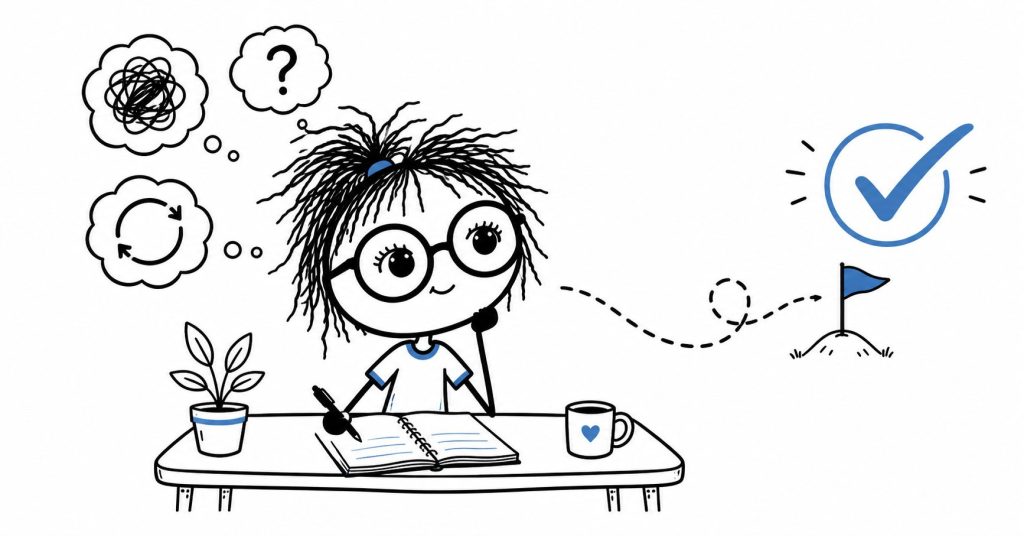
You have been calling it a clarity problem for a while now.
You cannot decide because you are not clear enough yet. You need more time. More information. More space to think. When the fog lifts, you will move. Until then, you are just being responsible.
That story is partly true.
It is also partly a very sophisticated negotiation tactic you have been running on yourself for longer than you want to admit.
Here is the thing about clarity.
Most people who say they are waiting for it already have it.
They know the direction. They have known it for a while. What they do not have is a settled relationship with the cost of going in that direction. So the mind goes back into session. Opens the debate again. Introduces new concerns. Considers the alternatives one more time. Generates fresh reasons to wait.
It calls the whole process seeking clarity.
That is not what it is.
What Negotiating With Yourself Actually Looks Like
You recognize it if you are honest.
You make a decision. A real one. Something settles.
Then, within hours or days, the negotiation reopens.
But what about the other option. But what if the timing is wrong. But what if there is something you have not thought of yet. But what if you are making this decision for the wrong reasons.
The concerns sound reasonable. That is part of the problem.
Because some of them are reasonable. Every real decision comes with legitimate uncertainty. But there is a specific point where legitimate uncertainty has been addressed and the negotiation continues anyway. Where new concerns are being generated not because they are genuinely new but because the mind needs a reason to stay in session.
That point is the line between discernment and delay.
And most people have crossed it without noticing.
The Internal Negotiating Table
Think of it this way.
When a decision stays perpetually open, you are running an internal negotiating table.
On one side: the direction you already know you want to go. The thing that keeps returning. The answer that was there before the analysis started.
On the other side: every fear, objection, practical concern, imagined consequence, borrowed opinion, and worst-case scenario your mind can generate.
The negotiating table operates on a specific rule.
The direction you want does not get to win until it addresses every objection the other side produces.
And the other side can always produce one more objection.
Which means the negotiation never ends.
Not because you lack clarity.
Because the table is rigged.
You have set up a process where the thing you already know has to defeat an opponent that regenerates indefinitely.
No amount of additional clarity wins that fight.
The only move that ends the negotiation is choosing to leave the table.
Why the Negotiation Keeps Reopening
Understanding why the table keeps reconvening is more useful than trying to think your way out of it.
The negotiation reopens because committing to a direction closes other directions.
And for people who are naturally multi-passionate, possibility-oriented, or deeply afraid of choosing wrong, the closing of options feels like loss even when the direction is right.
So the mind finds reasons to keep options open.
Not because the options are genuinely better.
Because open options feel safer than a committed direction that might not work out.
The negotiation is not solving a real problem.
It is managing a specific discomfort.
The discomfort of finality. Of accountability. Of the gap between choosing and knowing whether you chose well.
That gap is not solvable before the move.
It only closes after.
What Clarity Actually Is
Genuine clarity is not the absence of doubt.
It is not the moment when every concern has been addressed and the right choice is undeniably obvious.
For most real decisions, that moment does not arrive before you commit.
It arrives after.
You make the choice. You start moving. And somewhere in the early stages of actually doing the thing, the questions that felt impossible to answer become answerable. Not because you found new information, but because reality gives feedback that thinking never could.
Clarity, for most people, is not a precondition for action.
It is a product of it.
Which means the strategy of waiting for clarity before moving is precisely backwards.
You are waiting for the thing that your waiting is preventing.
The Difference Between Discernment and Delay
This is worth being precise about because they are genuinely different and the line between them matters.
Discernment is the process of getting honest about what you actually know, what you actually value, and what direction actually fits. It takes time. It requires genuine reflection. It is not the same as impulsive action and should not be rushed past.
Delay is what happens after discernment has done its work and the negotiation continues anyway.
Discernment produces movement toward a decision.
Delay produces more discernment.
If you have been in the same discernment process for more than a few weeks on the same question, with no new information arriving and no genuine movement toward resolution, you have probably crossed the line.
The honest question is not “do I need more clarity?”
The honest question is: “Has discernment finished its work and am I now just reopening the table because committing is uncomfortable?”
Most people already know the answer.
What Stopping the Negotiation Looks Like
Not permanent certainty. Not the elimination of doubt.
Just the decision to close the table.
That looks like naming the direction you already know. Not as a final commitment to the whole plan, but as an honest acknowledgment of what your discernment has already produced.
It looks like recognizing the next objection not as a new concern but as the negotiating table reopening. Noticing it. Not feeding it.
It looks like taking one real step in the direction you have been circling. Not the whole plan. One step that exists outside your head and in the actual world.
Because once you have taken a real step, something shifts.
The negotiating table loses some of its authority.
You now have real feedback to work with instead of imagined outcomes to argue about.
And real feedback, even when it is complicated, is almost always easier to navigate than the endless internal debate it replaces.
The Honest Reframe
You do not need more clarity.
You need to notice when you already have it and stop reopening the negotiation.
You need to name what the internal debate is actually protecting you from, which is almost never a bad decision and almost always the vulnerability of committing to something that matters.
And you need to recognize that the clarity you have been waiting for has probably been available for a while.
It has been sitting quietly on one side of the table, waiting for you to stop giving the other side another turn.
One Question
What direction keeps returning every time the negotiation quiets down?
Not the option that wins the debate.
The one that was there before the debate started.
That is probably your answer.
The negotiation is not protecting you from choosing wrong.
It is protecting you from choosing at all.
Stop negotiating.
Choose.