You make a decision.
A real one. Thought through, reasoned out, as well-considered as anything you have ever decided. And for approximately four minutes, it feels settled.
Then the second-guessing starts.
What if you missed something. What if someone smarter would have chosen differently. What if the initial instinct was right and this was the wrong call. What if you should have waited longer, researched more, asked one more person.
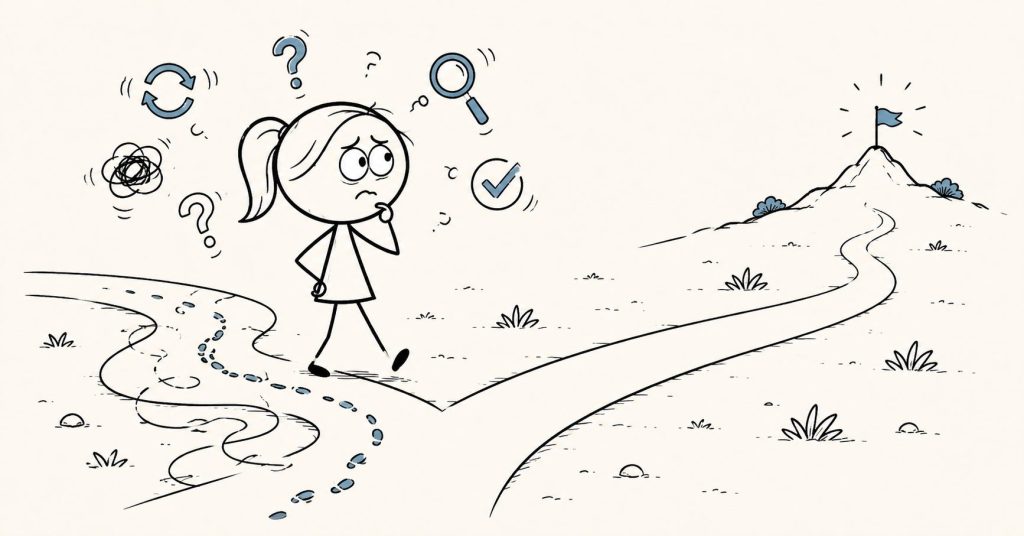
And then you are back in the loop. Not because new information arrived. Because your brain decided the decision was not safe yet. Not wrong. Not irrational. Not poorly researched. Just unsafe.
If you have ever asked, “Why do I second-guess myself after every decision?” the answer is probably not that you lack discipline. It is that your brain has learned to treat commitment as danger.
You have probably tried to fix this with willpower. With commitment rituals. With journaling prompts that ask you to affirm your choice until you believe it. With accountability partners who are supposed to hold you to what you decided before you talked yourself out of it.
And it keeps happening anyway.
Because willpower is not the problem.
And willpower is not the solution.
Why Willpower Fails at This Specific Thing
Willpower works on behavior.
It can make you go to the gym when you do not feel like it. It can make you close the laptop at a reasonable hour. It can make you not eat the third cookie, at least some of the time.
What willpower cannot do is override a belief.
Second-guessing yourself is not a behavior. It is a belief operating underneath your behavior. Specifically, it is the belief that your judgment is not quite reliable enough to trust without verification.
You can white-knuckle your way through one decision. You can force yourself to stay committed by sheer determination. But the belief is still there, running quietly underneath everything, waiting for the next decision to surface.
And it will surface. Because that is what beliefs do.
Willpower is a lid.
Self-trust is a replacement.
Those are not the same intervention. One suppresses the symptom temporarily. The other addresses what is actually producing it.
What Second-Guessing Actually Is
Here is the honest diagnosis.
Second-guessing is what happens when you do not have enough evidence that your judgment can handle being wrong.
Not that your judgment is always right. It is not. Nobody’s is.
But there is a specific fear underneath chronic second-guessing that is worth naming precisely: if I trust my judgment, commit to this decision, and it turns out to be wrong, I will not be able to handle what that means about me.
Not “I will have made a mistake.” People who trust themselves make mistakes and recover.
The fear is: if I am wrong about this, it will confirm something I have been quietly afraid of all along. That my discernment cannot be trusted. That I am not as capable of handling this as I have been pretending. That the doubt was right and the confidence was a performance.
That is the fear second-guessing is protecting you from.
And willpower cannot touch it. Because it is not a discipline problem. It is an evidence problem.
You do not have enough proof yet that your judgment survives being wrong.
Where the Pattern Usually Starts
Chronic second-guessing does not arrive out of nowhere.
It almost always has an origin.
Sometimes it is a decision that went badly in a way that felt significant. One call that cost something real. And your brain, which is in the business of keeping you from repeating painful experiences, filed it under “your judgment requires supervision.”
Sometimes it is a system that trained it into you. A family, a culture, an environment that consistently signaled that your instincts were slightly off. That the right move was to check, confirm, defer. That certainty before action was wisdom, not hesitation.
Sometimes you are just thoughtful in a world that rewards fast, loud certainty. You noticed nuance. You saw the downside. Then your strength turned inward and started cross-examining every choice like it was on trial.
None of these origins make the pattern rational.
They make it understandable.
Understanding where it comes from does not fix it. But it does prevent you from treating yourself like the problem when you are actually dealing with a learned pattern that can be unlearned.
Self-Trust Is a Skill. It Is Trained, Not Switched On.
This is the part most people have not heard.
Self-trust is not a personality trait you either have or do not have.
It is not confidence, which is more about presentation than internal certainty.
It is not the absence of doubt, which is a fantasy that has nothing to do with how capable people actually operate.
Self-trust is a skill built through a specific kind of evidence accumulation.
You make a decision. You stay with it. You handle whatever happens. You learn from what did not work. You do not collapse when you are wrong. You adjust and keep going.
Every time that cycle completes, you add to a body of evidence that your judgment can handle reality.
Not that it is always right. That it can handle the consequences of being wrong.
That distinction is the whole thing.
People who trust themselves are not people who never doubt. They are people who have decided, through accumulated experience, that they can survive being wrong and still function well on the other side of it.
The second-guesser has not yet gathered enough of that evidence. Or they have gathered it and are not counting it. Both are fixable.
What Actually Builds It
Not affirmations. Not mantras. Not a morning routine that starts with writing “I trust myself” ten times in a journal.
Those are fine. They are not the mechanism.
The mechanism is specific and somewhat unglamorous.
Make smaller decisions and honor them.
Not the big ones first. The small ones. The ones where the stakes are low enough that being wrong does not feel catastrophic. Choose the restaurant and do not apologize for it. Pick the direction for the project and stay with it for a week before reconsidering. Give yourself an opinion and let it stand without immediately softening it with “but I could be wrong.”
Small decisions, honored consistently, build the same neural pathway as large ones.
Your brain does not grade decisions by stakes. It grades them by pattern. And the pattern it needs to see is: I decided, I stayed with it, something happened, I handled it.
Repeat that enough times and the evidence starts to accumulate.
Stop asking for confirmation you do not need.
There is a version of seeking counsel that is genuinely useful. When you lack information, when someone has relevant expertise you do not, when a decision affects someone else who deserves input.
And there is a version that is second-guessing wearing a collaborative outfit.
You already know what you think. You are asking because you want someone else to absorb responsibility for the conclusion. Or because their agreement makes your judgment feel more legitimate. Or because saying it out loud to another person delays having to commit.
That kind of confirmation-seeking does not build self-trust. It erodes it. Every time you outsource a decision you were capable of making, you add to the evidence that your judgment needs assistance.
Notice when you are asking for information versus asking for permission.
Ask for information freely.
Stop asking for permission you already have.
Count your judgment accurately.
Most chronic second-guessers keep very poor score.
The decisions that worked out, the instincts that were correct, the calls that held up under real-world pressure — these do not get logged. They are taken for granted, or attributed to luck, or immediately overshadowed by the next thing to worry about.
The decisions that went wrong get logged extensively. Reviewed. Stored in a prominent mental location for easy retrieval when doubt needs ammunition.
That is not an honest accounting.
Go back. Deliberately. Count the times your judgment was right. Not to inflate your ego. To correct the record.
The evidence of your competence is probably more extensive than you are currently counting.
The Question Underneath the Second-Guessing
Every chronic second-guesser is ultimately asking the same thing, even when they do not frame it this way.
If I trust myself and I am wrong, can I survive it?
The honest answer, for most capable people, is yes.
You have survived being wrong before. Not always gracefully. Not without cost. But you adjusted. You kept going. You are still here, still thinking, still making decisions.
The catastrophe your brain is protecting you from has already happened to you in smaller forms.
And you handled it.
That is the evidence you keep forgetting to count.
If Second-Guessing Is Running Your Decisions Right Now
The pattern has a source.
For some people it is the research loop that never closes. For others it is the comparison spiral that keeps generating doubt by measuring against the wrong standard. For others it is a deeper identity question about whether they are actually the person who gets to make confident decisions.
The Why You’re Still Stuck quiz identifies which pattern is underneath yours specifically.
Seven questions. Not a personality label. A specific read on what is driving the doubt and what would actually address it.
That is a better starting point than trying to bully yourself into confidence for the 400th time.
Take the quiz. Find the pattern. Then stop treating every decision like a courtroom drama.
You cannot solve what you have not named.
Why You’re Still Stuck (It’s Not What You Think)
7 questions. Uncomfortably accurate. This is not a personality quiz. It is a diagnosis.
TAKE THE QUIZ →