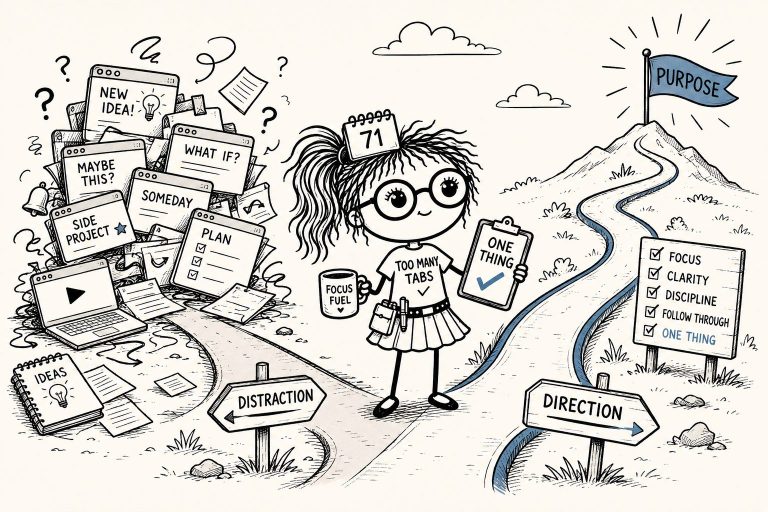
She is sitting at her massive oak desk. There are 71 tabs open in her browser, a color-coded planner with a new business idea, a 2-month-old college application, and a leather journal she bought 8 months ago with a short story half written.
She is multitalented. She is passionate. She wants to have a meaningful life. She does not want to waste any of her gifts.
She is good at many things, even great at some of them, but she is not seriously pursuing any of them because she is afraid to choose wrong.

Sometimes she does start one of them, but it rarely gets beyond the initial stage.
Her name is Tabitha.
I was her.
You may be her as well.
Look further back than your résumé
Since I was a little girl, I loved performing. Dancing, acting, singing, public speaking, you name it. I was also pretty good at most of them, except maybe singing, and I assumed everyone else was too.
It was not the attention I loved. I was pretty introverted and liked being alone. I also did not spend my childhood dreaming about becoming a professional actor or dancer.
What I loved most about being on stage was the ability to change someone’s mood or mind.
That opportunity made me so giddy and excited that I often had a hard time containing myself. For those who know me, that is saying a lot. I am not very expressive. I am a fairly typical Eastern European who can be extremely excited on the inside while looking like I am waiting for a bus.
But excited I was.
I feel something very similar now when I help people figure out their lives. When something I say helps them see themselves differently. When advice, comfort, teaching, or even a well-timed rebuke changes something for them.
That is why one way to get out of Tabitha syndrome and collect useful evidence about which direction may actually be yours is to look at your childhood.
Not because your 9-year-old self had your career figured out.
Because childhood gives you clues.
Who were you before life knocked some dreams out of you? Before you started listening to voices from every area of your life and letting other people tell you what was practical, respectable, realistic, or worth pursuing?
What made you happy?
What made you excited?
What made time disappear when you were a child?
Think about it for a while. Do not rush. Do not dismiss something because it sounds silly now.
Maybe you loved doing your doll’s hair or your friend’s hair.
That does not mean you are secretly called to become a hairdresser.
The activity itself may not be the important part.
What did you love about it?
Was it creating beauty?
Was it transformation?
Was it watching your friend look in the mirror and feel prettier?
Was it the feeling that something was different because you had touched it?
The emotion underneath the activity matters.
Once you identify that, look across the rest of your life.
When else did you feel the same way?
What were you doing?
Did it feel meaningful?
Did you become so absorbed that time went by ridiculously fast?
Take your time with this. Look for patterns across your life by paying attention to what you were doing when you felt most alive.
Maybe it was reading to your children.
Maybe skiing.
Maybe giving advice to a friend.
Maybe cooking.
Maybe organizing somebody’s bridal shower.
Maybe sitting in traffic, although I doubt it. I wanted to leave room for surprises.
The point is not the activity itself.
The point is the pattern underneath it.
What problem keeps bothering you?
Then ask yourself something completely different.
What makes you mad?
Not mildly annoyed. I do not mean the driver sitting in the left lane going 12 miles under the speed limit. That may be deeply offensive, but it is probably not your calling.
I mean the problems that repeatedly bother you enough that you want to understand them, improve them, teach about them, fix them, or help the people affected by them.
Sometimes one of the strongest clues is the problem you cannot seem to ignore.
What keeps getting your attention?
What do you find yourself talking about over and over?
What do you wish somebody would fix already?
What problem makes you think, “Somebody needs to do something about this”?
And then, occasionally, the uncomfortable realization arrives.
Maybe that somebody is you.
What actually fits your life right now?
Now comes the third filter.
What fits your current season?
You may genuinely want to become a flight attendant, but if you just had a baby and cannot imagine leaving your child for days at a time, that dream may not fit this season.
That does not make the dream fake.
It means not now.
Maybe it becomes possible 10 or 15 years from now.
Close the tab for this season.
Money matters too. Responsibilities matter. Children matter. Health matters. Capacity matters.
If you are supporting your family and have bills to pay, quitting tomorrow because you suddenly discovered your true calling is probably a terrible financial plan.
You may be able to start small. Weekends. One client. One class. One article. One experiment.
But some dreams belong on the shelf until the timing changes.
Closing a tab does not mean destroying the dream.
It means deciding that it is not an active assignment right now.
It can stay on the shelf without staying open in your head.
That distinction matters, especially for people with a lot of interests.
Choosing one direction can feel like abandoning the others.
You are not abandoning them.
You are stopping all of them from competing for active custody of your time at once.
So, to sum up:
- What did you love as a kid?
- What makes you mad?
- What tabs make sense in this season?
You are looking for overlap, not a perfect answer.
If one direction stubbornly keeps showing up in the patterns of your life, connects to a problem you genuinely care about, and actually fits in your current season, pay attention to it.
It does not mean that you have to commit to this idea forever. It means that it has earned the right to get your serious attention right now.
Spend enough time with it to become real before you reopen the other tabs.
Close the tabs that belong to another season.
Pick the one with the strongest evidence.
Give it enough time to become real.
If you do this exercise and still end up staring at 5 different directions that all seem equally convincing, send me an email.
Sometimes the pattern is easier to see when someone else is looking at the whole picture.
You cannot solve what you have not named.
Why You’re Still Stuck (It’s Not What You Think)
7 questions. Uncomfortably accurate. This is not a personality quiz. It is a diagnosis.
TAKE THE QUIZ →If you keep researching long after the missing information should have been found, read How Do I Know If I Need More Information or I’m Just Afraid to Decide?