You do not need another late-night search for “should I change careers?”
You have probably already done that.
You have read the articles. Watched the videos. Taken the career quiz. Saved the posts. Maybe even made a pros and cons list that looked responsible but solved absolutely nothing.
That tracks.
Because when you feel stuck, researching feels like movement.
It gives your brain something to do while avoiding the thing that actually changes your life: making a decision and taking a real step.
The real problem may not be that you do not know what to do.
The real problem may be that every option still feels open.
Stay where you are.
Quit.
Change jobs.
Go back to school.
Start the business.
Move into a new field.
Do something “safe.”
Do something “brave.”
Do something your family understands.
Do something your actual nervous system does not hate.
That is a lot of mental tabs for one person to keep open. No wonder you are tired.
Career change is rarely just about work. It touches money, identity, fear, confidence, family expectations, your future, and that tiny little voice in your head asking, “What if I ruin my life?”
Dramatic? Maybe.
But also honest.
So let’s talk about how to know whether you should change careers, stay where you are, quit your job, or pivot into something new without turning your life into a permanent research project.
First, Stop Calling Every Career Problem a Career Change Problem
Not every miserable work season means you need a new career.
Sometimes you need a new job.
Sometimes you need a new manager.
Sometimes you need stronger boundaries.
Sometimes you need to stop treating burnout like a personality trait.
Sometimes you need a full career pivot because the field, role, or lifestyle no longer fits who you are becoming.
The mistake is lumping all of that under one giant, terrifying question:
“Should I change careers?”
That question is too big.
No wonder your brain shuts down and asks for snacks.
A better question is:
What exactly is not working?
Is it the work itself?
The schedule?
The pay?
The people?
The values of the organization?
The lack of growth?
The emotional drain?
The fact that you are good at the job but dead inside by 3:17 p.m.?
Specificity matters. You cannot solve a foggy problem. You can only circle it.
Signs You May Need a Career Change
A career change may be worth considering if the actual work no longer fits you, not just the current workplace.
Here are some signs:
You are consistently drained by the core tasks of the work, even when the environment is decent.
You cannot see a future in the field without feeling trapped.
The skills you use most often are not the skills you want to keep building.
Your values and the work have started arguing with each other.
You feel like you are performing a version of yourself that made sense years ago but does not fit anymore.
You are not just tired. You are misaligned.
That last one matters.
Tired can be repaired.
Misaligned has to be addressed.
A vacation might help burnout. It will not fix the fact that you are spending your life in work that no longer fits your wiring.
Signs You May Not Need a Full Career Pivot
Before you blow up your resume and start Googling “best careers for people who hate meetings,” slow down.
You may not need a full career pivot if the problem is more connected to the environment than the field.
Maybe you still enjoy parts of the work.
Maybe you like the subject matter but hate your current workplace.
Maybe you are underpaid, underused, or micromanaged.
Maybe you are burned out from volume, not the work itself.
Maybe you are bored because there is no growth path.
This is where people get themselves in trouble.
They confuse “I need a better situation” with “I need an entirely new identity.”
Those are not the same thing.
If the field still has energy for you, the first move may be changing jobs, roles, schedules, or settings before making a full career change.
That does not sound as dramatic as “I quit everything and moved to a cottage to make pottery,” but it may be the smarter move.
Your mortgage does not care about your aesthetic reinvention.
The Real Career Question: Stay, Quit, or Pivot?
Most people thinking about career change are not choosing between one obvious good option and one obvious bad option.
That would be too easy.
They are usually choosing between several imperfect options.
Stay in the current job and make it work.
Change jobs but stay in the same field.
Pivot into a new field.
Go back to school.
Start a business.
Build something on the side.
Take a temporary bridge job.
Each option has a cost.
Each option has a benefit.
And each option has a fear attached to it.
This is why “follow your passion” is weak advice.
Passion does not pay the electric bill by itself.
But “just be practical” is also weak advice.
Practicality without alignment can turn into a slow leak of your actual life.
You need both honesty and structure.
Not vibes.
Not panic.
Not another personality quiz that tells you you are “creative, thoughtful, and driven.”
Lovely. Still stuck.
Career Clarity Comes From Evidence, Not Endless Thinking
At some point, more thinking stops helping.
That does not mean you should be reckless. It means you need to stop pretending research is the same as movement.
Reading about career change is not changing careers.
Watching people talk about career pivots is not testing a direction.
Saving job postings is not making a decision.
Updating your resume for the seventh time without applying anywhere is not a strategy. It is office supplies with anxiety.
Career clarity comes from evidence.
Evidence looks like:
Having one real conversation with someone in the field.
Applying to three roles and seeing what happens.
Testing a small version of a business idea.
Comparing your options against actual criteria.
Looking at income honestly.
Naming what your gut already knows.
Taking one step that creates new information.
Thinking can help you prepare.
Action gives you data.
And if you are stuck, data is what you need.
Six Questions to Ask Before You Change Careers
Before you make a major career decision, run your options through these six questions.
Do not just think about them.
Write the answers down.
Your brain is very good at turning discomfort into fog. Paper is less easily impressed.
1. Does this career option fit my energy?
Do not ask, “Could I do this?”
You can probably do many things.
That is part of the problem.
Ask:
Does this work give me energy on a typical day, not just an exciting day?
Some careers look good in fantasy form.
The title sounds nice.
The lifestyle looks appealing.
The social media version is adorable.
But the daily work? Different story.
Choose based on the Tuesday morning version, not the highlight reel.
2. Can this option meet my income reality?
Money is not everything.
But pretending money does not matter is how people make spiritual-sounding decisions with financial consequences.
Ask:
Can this option realistically meet my financial needs within a realistic timeline?
Not eventually.
Not in some magical future where everything works because you were “brave.”
Within a real timeline.
If the answer is no, that does not mean the direction is wrong.
It may mean the timing, strategy, or transition plan needs work.
You may need a bridge job.
You may need to test it on the side.
You may need to build skills before you leap.
That is not failure. That is adulthood.
Annoying, but useful.
3. Does this fit who I actually am?
Career confusion often comes from choosing based on who you think you should be.
The impressive version.
The acceptable version.
The version your family understands.
The version LinkedIn claps for.
Ask:
Does this fit who I actually am, not who I want others to think I am?
Some career options are not aligned. They are costumes.
They look like ambition, but they are really approval-seeking with a better outfit.
You do not need a career that performs well at Thanksgiving dinner.
You need work that fits the person who has to live your actual life.
4. Is this practically feasible?
A career option can be meaningful and still require planning.
Ask:
Do I have, or can I realistically get, what this direction requires?
Skills.
Time.
Money.
Credentials.
Support.
Access.
Experience.
This is not where you crush the dream. This is where you stop treating the dream like it lives outside reality.
A real direction can survive practical questions.
A fantasy usually gets offended.
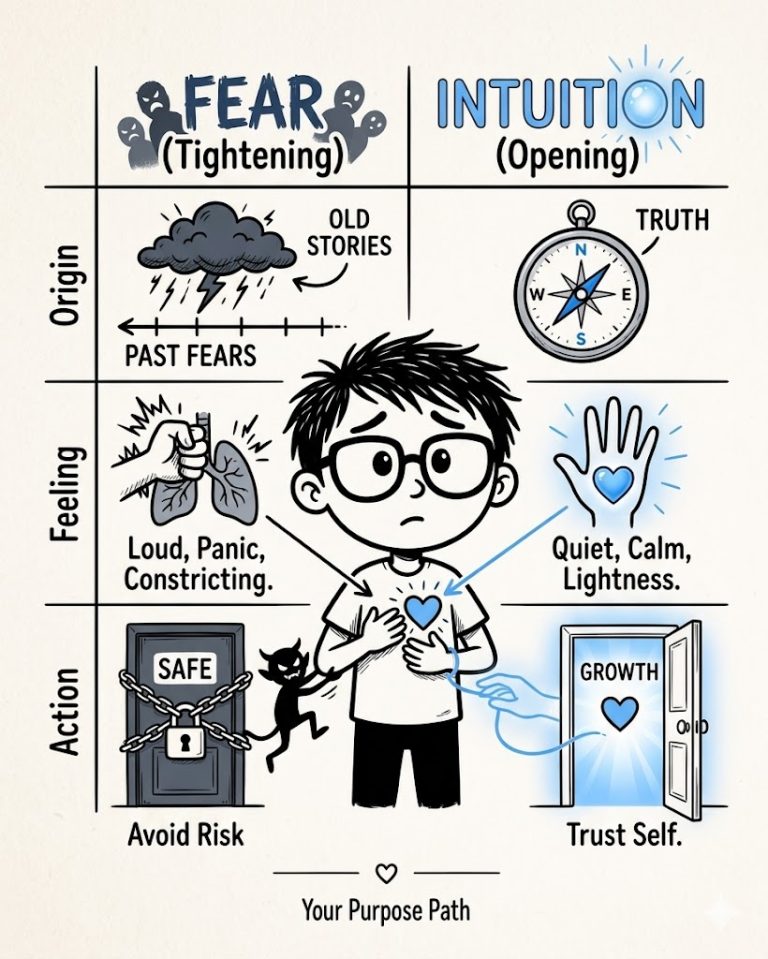
5. Is my hesitation legitimate concern or fear in a blazer?
Fear is sneaky.
It loves to sound responsible.
It says:
“I just need to be wise.”
“I should research more.”
“I do not want to rush.”
“I need a clearer plan.”
Sometimes that is true.
Sometimes fear has put on a blazer, grabbed a clipboard, and started calling itself discernment.
Ask:
Is this concern actionable, or is it just a polished excuse to stay where I am?
A legitimate concern deserves planning.
Fear deserves honesty.
Different problems. Different solutions.
6. What does my gut say when I imagine committing?
Your body often tells the truth before your spreadsheet finishes loading.
Ask:
When I imagine fully committing to this option, do I feel dread, heaviness, relief, peace, energy, or expansion?
Do not over-mystify it.
Just notice.
If one option gives you relief and another gives you dread, that is data.
Not the only data.
But data.
And if you immediately start arguing with the option that gives you relief, pay attention.
Sometimes the answer is not hidden.
Sometimes you just do not like what it requires.
The Career Change Trap: Waiting Until You Feel Certain
Many people stay stuck because they are waiting for certainty before they move.
That sounds reasonable.
It is also how people lose years.
You may never feel fully certain before a career change.
You may never get a perfect sign.
You may never have a risk-free plan.
You may never find the option that gives you excitement, money, approval, peace, identity alignment, and zero inconvenience.
That option is not a career.
That is a fantasy product sold in the Overthinking Mall.
Real career decisions involve tradeoffs.
The goal is not to remove all risk.
The goal is to choose the option with the strongest current evidence and take the next responsible step.
Not the whole staircase.
Not the dramatic exit.
Not the “new year, new me” performance.
The next step.
Should You Quit Your Job?
Maybe.
But do not quit just because you are overwhelmed today.
Also do not stay just because you are scared.
Ask better questions first:
Have I identified the actual problem?
Have I explored whether this is a job issue or a career issue?
Have I looked honestly at income?
Have I tested the next direction in some small way?
Have I made a transition plan?
Have I separated fear from legitimate concern?
Have I stayed too long because the familiar feels safer than the unknown?
That last question may sting.
Let it.
A job can be “fine” and still be wrong for the season you are in.
A career path can be respectable and still not fit anymore.
A paycheck can be steady and still cost more than it pays.
But quitting without clarity is not courage.
It is panic with better branding.
Should You Pivot Careers?
A career pivot may be the right move if your current path no longer fits your energy, identity, values, or long-term direction.
But pivoting does not always mean starting from zero.
You may be able to carry skills forward.
You may be able to move into an adjacent field.
You may be able to shift industries without abandoning everything you have built.
You may be able to test the pivot before making it permanent.
This is important because people often imagine career change as a cliff.
In reality, many pivots are bridges.
You are not necessarily throwing away your past experience.
You are reorganizing it around a better direction.
That is different.
Do not burn down the whole house if what you need is a new floor plan.
What If You Already Know the Answer?
Here is the uncomfortable part.
Some of you already know.
You know whether you need to stay and rebuild.
You know whether you need to leave the job but not the field.
You know whether the pivot is real but the timing needs planning.
You know whether the business idea is not a quit-tomorrow plan, but it is something you need to test.
You know whether school is a wise next step or a very expensive way to avoid making a decision.
You know.
You just keep asking the question because the answer requires a commitment.
That is not confusion.
That is self-trust work.
And no career article can do that part for you.
Rude, but true.
Before You Stay, Quit, or Pivot, Run the Decision Through a Filter
If you are stuck in career indecision, do not start with a dramatic life announcement.
Start with a filter.
Compare your real options.
Score them honestly.
Look at what the evidence says.
Then decide your next move.
That is why I created The Stay, Quit, Pivot Filter.
It is a free career decision tool from Your Purpose Path that helps you compare your actual career options against six honest criteria:
Energy fit.
Income reality.
Identity alignment.
Practical feasibility.
Concern validity.
Gut response.
It takes about 20 minutes.
Not three months.
Not another year of “figuring it out.”
Twenty minutes.
You will walk away with a clearer picture of which option has the strongest current evidence, whether your hesitation is a legitimate concern or fear wearing a responsible outfit, and what next step makes sense now.
No quiz.
No personality type.
No fluffy “follow your dreams” nonsense.
Just your real options, evaluated honestly.
Download the free Stay, Quit, Pivot Filter here
Before you quit, enroll, pivot, or spend another year circling the same decision, run it through the filter.
Your future does not need another open tab.
It needs a decision.
Already down to one or two options? The paid 71 Tabs Career Reset is a $37 workbook that accounts for your income, time, and responsibilities, then ends with a next move plan and a date to review it.