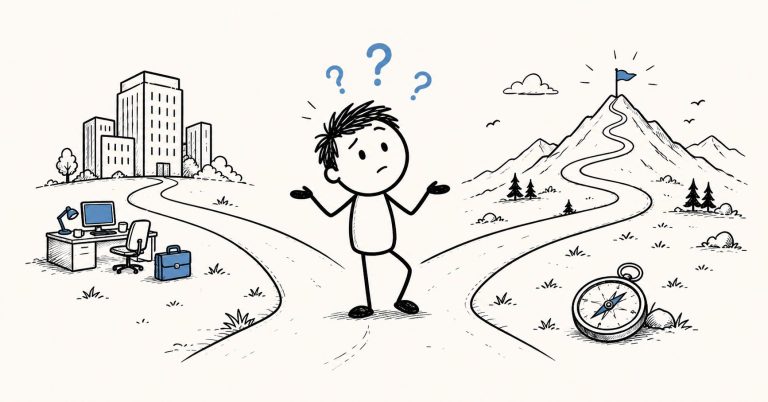
If you are searching for how to make a career change without starting over, you are likely not afraid of change itself. You are afraid of wasting everything you have already built.
That is a different problem, and it has a different solution.
A career change does not automatically mean starting at the bottom, taking a massive pay cut, going back to school for five years, or pretending the last decade of your life was just a weird side quest. Sometimes it means keeping what still has value, releasing what no longer fits, and testing the next direction before you make a move you cannot reverse.
That is the part most people miss. They think the choice is either stay miserable or start completely over. No wonder they freeze. One feels like slow professional suffocation. The other feels like financial panic wearing a motivational quote.
A career change without starting over is not about erasing your past. It is about using your experience differently.
Can You Change Careers Without Starting Over?
Yes, if you stop treating your entire work history like one giant mistake.
Your skills do not disappear because you change direction. Your judgment, your relationships, your credibility, your communication ability, your problem-solving, your leadership, your teaching, your planning, your writing — none of that vanishes because you are done with a particular role or industry. You may not want to use those skills in the same way anymore. That is different.
The better question is not, “Do I have to start over?”
The better question is: Which parts of my current career still have value, and which parts no longer fit?
That question gives you something useful to work with. Panic does not.
Why Career Change Feels Like Starting Over
Career change feels terrifying because most people are not only questioning a job. They are questioning an identity.
Maybe people know you as “the teacher,” “the nurse,” “the manager,” “the counselor,” “the corporate person,” “the responsible one.” Then one day you realize you are tired. Not lazy tired. Not “I need one good weekend and a snack” tired. A deeper kind of tired.
You are tired of performing a version of yourself that technically works, but does not feel like the full truth anymore.
That is when the fear gets loud.
What if I wasted all this time? What if I make less money? What if I am too old to switch? What if I pick the wrong thing? What if I leave and regret it? What if I stay and regret that too?
Now your brain is running a full career committee meeting every day before breakfast. Very productive. Also exhausting.
Here is what that loop usually means: this is not primarily a career problem. It is a self-trust problem. The real bottleneck is not that you lack information. It is that you do not yet trust your own judgment enough to choose a direction and move without waiting for the world to sign off first. More research, more planning, more thinking — none of that solves a self-trust deficit. It just gives it better disguise.
The fear makes sense. But fear is a terrible strategist. It turns every decision into an emergency. That is why you need a filter before you make a move.
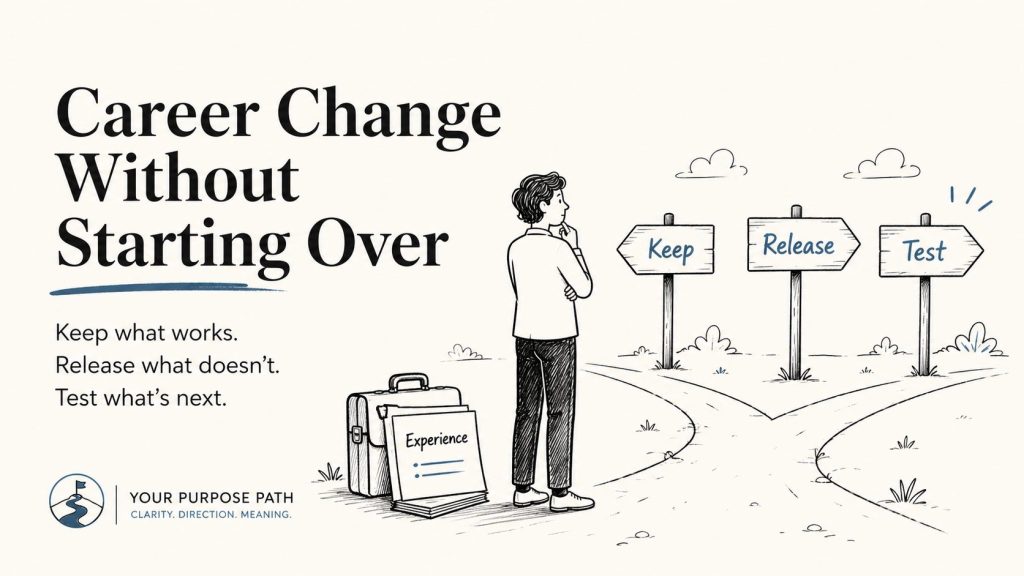
The 3-Bucket Career Pivot Method
If you want a career pivot without starting over, sort your current career into three buckets:
- Keep
- Release
- Test
Simple. Useful. Harder to dodge than another personality quiz.
The goal is to stop asking, “Should I blow up my whole life?” and start asking, “What still belongs, what needs to go, and what needs real-world testing?”
That is a much better question.
Bucket 1: Keep What Still Has Value
Before you quit, pivot, enroll in another program, or decide your entire career was a mistake, identify what you should keep.
Because there is something.
Even if you are burned out. Even if your current job makes your eye twitch. Even if the Sunday Scaries have moved in permanently and started receiving mail.
Your current career has given you assets. The question is which ones still belong in your next chapter.
Start with your transferable skills. Ask yourself:
- What do people come to me for?
- What problems am I good at solving?
- What tasks feel easier to me than they seem to feel for other people?
- What have I learned how to do under pressure?
- What skills do I use across different jobs, roles, or settings?
Do not only list job-title skills. List actual working skills.
A teacher may have skills in communication, training, curriculum design, group facilitation, behavior management, and conflict resolution. A nurse may have skills in patient education, crisis response, documentation, decision-making, and systems navigation. A retail manager may have skills in operations, sales, hiring, customer experience, inventory, leadership, and team development. A counselor may have skills in assessment, listening, coaching, documentation, planning, teaching, and helping people make decisions.
Those skills are not trapped in one job title. They can move.
Also look at your experience. What kinds of people do you understand well? What situations have you handled repeatedly? What patterns can you spot faster because of your experience? What problems do you understand from the inside? What credibility have you already earned?
Your next direction may not be a random leap. It may be a smarter use of what you already know.
You are not starting from nothing. You are starting from evidence.
Bucket 2: Release What No Longer Fits
Now comes the uncomfortable part. You need to name what you are done carrying.
Not everything from your current career deserves to come with you. Some of it is useful. Some of it is expired. Some of it is an identity costume you keep wearing because other people recognize you in it.
Start with the role.
Do you still want this role, or are you just good at it? Would you choose this path again today? Are you staying because it fits, or because it is familiar? Does this role use the best of you, or just the most available parts of you?
Many capable people get stuck here. Being good at something is not the same as being meant to keep doing it forever. Competence is not a sentence.
Also look at the environment. Sometimes you do not need a whole new career. You need a healthier workplace, better leadership, a different schedule, or a different structure.
Ask yourself: Is the problem the work or the workplace? Is the issue the industry or this organization? Is the issue the career path or the leadership?
Burnout can make every option look wrong. Exhaustion is a terrible career advisor. Before you decide to blow up your professional life, make sure you are not making a permanent decision from a depleted state.
Then look at your old definition of success.
Maybe success used to mean stability at all costs. Maybe it meant a respected title. Maybe it meant being impressive. Maybe it meant never disappointing anyone. Maybe it meant staying because quitting would make people talk.
If your definition of success was built by people who do not have to live your daily life, it may be time to stop letting it drive.
Ask: What version of success am I still trying to satisfy? Who benefits from me staying where I am? What am I afraid people will think if I change direction? What would I choose if I did not have to explain it to anyone for six months?
That answer may tell you more than another career assessment.
Bucket 3: Test the Next Direction Before You Leap
This is where people mess up. They wait too long because they want certainty. Then they get frustrated and make a dramatic move because they are tired of waiting.
Both can create a mess.
The better option is to test.
A career change without starting over should be built on evidence, not panic. You do not need to know the entire path before you take a step. But you do need to stop making huge decisions based only on frustration, fantasy, or someone else’s highlight reel.
Testing can look like this:
- Talk to three people doing the kind of work you are considering
- Take on a small freelance project
- Volunteer in a related area
- Create a sample project
- Take one short, affordable training before committing to a degree
- Rewrite your resume for the direction you are considering and see what gaps appear
- Apply to a few roles and study the response
- Build a small offer or service on the side
- Use evenings, weekends, or vacation time to test a new skill
The point is not to make the perfect move. The point is to collect real-world evidence.
Thinking gives you theories. Testing gives you data. And data is much more useful than another 2 a.m. spiral.
Before you test, ask: What am I trying to find out? What would make this direction worth pursuing further? What would be a warning sign? What small experiment can I run without wrecking my finances? What existing skill can I use to enter this new space?
This keeps you from confusing movement with impulsiveness.
Movement has structure. Impulsiveness is what happens when frustration grabs the steering wheel.
How to Change Careers Without Losing Income Immediately
One of the biggest fears around career change is money.
Fair.
Bills do not care that you are “aligned now.” Rent is not moved by your personal growth journey. So let’s be adults.
If you want to change careers without losing income immediately, you need a bridge strategy.
That may mean:
- Keeping your current job while testing the next direction
- Moving to a related role before making a bigger pivot
- Changing industries but keeping the same function, or changing function but staying in the same industry
- Building a side income before leaving
- Negotiating your current role while preparing your exit
- Reducing expenses before making a move
- Creating a six-month transition plan instead of rage-quitting on a Tuesday
A bridge strategy may not feel exciting. Good. Exciting is not always the goal. Sometimes the goal is to move without creating a financial mess your future self has to clean up.
Career change does not need to be reckless to be bold. Sometimes the boldest move is building the bridge carefully and walking across it on purpose.
Stay, Quit, or Pivot?
Before you decide what to do, you need to know what kind of problem you actually have.
“I need a career change” can mean several different things. You may need to stay and restructure. You may need to quit and leave the environment. You may need to pivot and use your skills differently.
These are not the same move.
Stay may be right if:
- The work still fits, but your boundaries are weak
- The environment is imperfect but not damaging
- You still have growth available
- You are in a temporary hard season, not a permanent mismatch
- You need more structure before making a move
Quit may be right if:
- The environment is harming your health, values, or stability
- Leadership is toxic and unlikely to change
- The role consistently drains you with no meaningful return
- You have already tried reasonable adjustments
- Staying would cost more than leaving
Pivot may be right if:
- Your skills are still valuable, but the role no longer fits
- You like parts of the work but need a different audience, industry, or setting
- You are not done with the field, but you are done with your current version of it
- You keep feeling pulled toward related work that uses your experience in a new way
- You want change, but not a full professional reset
Most people skip this step. They ask, “Should I leave?” before they have clarified what exactly needs to change. That is how people make expensive decisions with blurry information.
Do not do that.
Final Word: Your Experience Is Not the Problem
If you are afraid of starting over, look closer. You may not be afraid of the next career. You may be afraid that the career you built will no longer count.
But your experience counts. It may just need to be translated.
Keep the skills. Keep the wisdom. Keep the credibility. Keep the parts that still feel true.
Release the role, environment, identity, expectations, or old definition of success that no longer fits.
Then test the next direction with enough honesty to get real evidence.
That is how you pivot without starting from scratch. Not by waiting until certainty drops from the ceiling. Not by blowing up your life because you had one bad week and watched three inspiring YouTube videos.
By filtering what still belongs, releasing what does not, and testing what might be next.
Less drama. Better decisions.
Not Sure What Is Actually Keeping You Stuck?
Before you quit, enroll, pivot, or spend another year circling the same decision, get honest about what is actually going on underneath the indecision.
Because here is the thing most career advice skips: the problem is rarely the career itself. More often, it is a self-trust problem dressed up as a career problem. You have been waiting for more information, more certainty, more confirmation from the world. But none of that arrives. Because that is not what the problem is.
Take the free quiz at Your Purpose Path to find out exactly what pattern is keeping you stuck. Seven questions. Uncomfortably accurate. Takes two minutes and gives you something you can actually work with.
You do not need to burn everything down. You need to stop carrying what no longer fits and start using what still does.
Before you quit, stay, enroll, pivot, or spend another year circling the same decision.
Get the Free Stay, Quit, Pivot Filter
If your career decision keeps looping in your head, the problem may not be lack of information. You may need a cleaner way to compare your real options.
The Stay, Quit, Pivot Filter is a free 20-minute career decision tool that helps you score your options against six honest criteria: energy fit, income reality, identity alignment, practical feasibility, concern validity, and gut response.
No quiz. No personality type. No fluffy “follow your dreams” speech. Just your actual options, evaluated honestly.
Send Me the Free Career FilterTakes about 20 minutes. Gives you a real starting point.