You have been waiting for clarity.
Maybe for a while now.
You are waiting to feel certain. Waiting to feel settled. Waiting for the noise to quiet down long enough that one direction finally rises above the others and announces itself with enough conviction that you can move without second-guessing it every three days.
You are waiting for a feeling.
And the feeling keeps not arriving.
So you do more. More journaling. More research. More conversations with people whose opinions you trust. More quiet time. More assessments. More sitting with it, letting it breathe, giving it space.
All of which are reasonable things to do.
None of which are producing the clarity you are waiting for.
There is a reason for that.
Clarity is not a feeling that arrives.
It is a decision you make.
What We Have Been Taught About Clarity
Most of what people believe about clarity is wrong.
Not wrong in a malicious way. Wrong in the way that myths get passed around because they sound true and nobody challenges them until someone has spent several months or several years acting on them with nothing to show for it.
The myths sound like this.
Clarity comes when you do enough inner work.
Clarity comes when you get quiet enough to hear yourself.
Clarity comes when you have processed the options long enough.
Clarity comes when you are finally ready.
All of these contain a grain of truth.
All of them are also missing the most important part.
Because what they describe is a process of preparation. And preparation is not the same as clarity. Preparation is what you do while you are waiting. Clarity is what happens when you stop waiting and choose.
The Loop That Preparation Creates
Here is what the preparation approach actually produces in most people.
More information. More perspectives. More angles to consider. A richer, more detailed map of the territory.
And a decision that is no closer than it was before.
This is the clarity loop.
You feel unclear. You prepare more. You feel slightly better. But not clear enough to move. So you prepare more. The loop sustains itself because the preparation always produces something useful, which justifies continuing it. You are never wasting time. You are always doing something reasonable.
What you are not doing is deciding.
And here is the thing the loop obscures: the clarity you are waiting for is not available in the preparation phase. It is only available on the other side of a choice.
You cannot think your way to clarity about a direction you have not yet chosen.
You can only choose a direction and then gain clarity as you walk it.
What Clarity Actually Is
Clarity is not the absence of doubt.
It is not perfect certainty.
It is not the feeling that everything finally makes sense and the right path is undeniably obvious.
Those things occasionally happen. But they are rare, and waiting for them as a precondition for movement means most people will wait for a very long time.
Real clarity is simpler and less cinematic than that.
Real clarity is knowing enough to take the next step.
Not the whole journey. Not every turn. Just the next step. The one that is actually in front of you right now.
That level of clarity is almost always available.
You usually already have it.
What you are missing is not information about the next step. What you are missing is the decision to take it.
The Difference Between Clarity and Certainty
This distinction is the one most people never make, and it is the one that keeps them stuck the longest.
Clarity and certainty are not the same thing.
Certainty is knowing the outcome before it happens.
Clarity is knowing what to do next.
You are not going to get certainty. Not before you move. Not about any decision that actually matters. The outcome of a real choice is not available in advance. If it were, it would not be a choice. It would just be a transaction.
But clarity you can have.
Right now, in the middle of all the uncertainty, with all the noise still running, with no guarantee of how it will turn out, you can be clear about one thing.
What is the next honest step?
Not the whole plan. Not the five-year vision. Not the answer to every question currently open in your mind.
What is the next honest step?
If you sit quietly with that question for two minutes, you probably know the answer.
You have probably known it for a while.
The problem is not that you are unclear.
The problem is that you have been treating the absence of certainty as the absence of clarity.
It is not.
Why Deciding Produces Clarity Instead of the Other Way Around
This is the part that feels backwards until you have experienced it.
Decision does not follow clarity.
Clarity follows decision.
When you are still deciding, everything is available and nothing is settled. Your brain stays in evaluation mode, which means it keeps generating options, concerns, alternatives, and questions. It is doing its job. But that job is not the same as moving.
The moment you make a real decision, something shifts.
Not because the uncertainty disappears. It does not.
But because the question changes.
Before the decision, the question is: what should I do?
After the decision, the question is: how do I do this well?
That second question is productive. It generates useful information. It produces traction. It is the question that leads somewhere.
The first question, held indefinitely, just produces more options.
Deciding does not eliminate the fog.
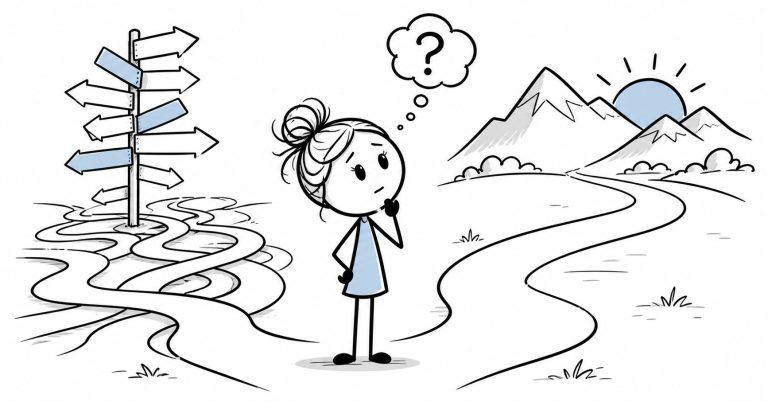
It gives you a direction to walk in despite it.
And walking in a direction despite the fog is what produces clarity. Not the other way around.
What Clarity Actually Requires
Three things. Not ten.
A filter.
You cannot get clear in the middle of noise. Not because quiet is magical, but because clarity requires you to distinguish your actual signal from everything competing with it. Other people’s timelines. Fear dressed up as wisdom. Options that are genuinely good but not genuinely yours. Urgency that belongs to someone else’s priorities.
Most of what people call unclear thinking is actually unfiltered thinking. The direction is in there. It just has too much company.
A commitment to one thing.
Clarity is not compatible with keeping all options permanently open.
This is the part people resist most. Choosing one direction feels like loss. Like closing doors. Like admitting that the other options were not right.
But here is what indefinite openness actually costs: it costs you the clarity that comes from committing. It costs you the momentum that builds when you stop splitting your attention between everything and give one thing a real shot. It costs you the evidence that only comes from actually moving.
One direction is not the death of your other possibilities.
It is the only environment in which any of them can actually breathe.
A willingness to move before you feel ready.
This is the one that most clarity-seeking collapses on.
Readiness is not a precondition for clarity. It is a result of it.
You will not feel ready before you move. You will feel ready approximately ten steps in, after it is slightly too late to turn back comfortably. That is not a design flaw. That is how it works.
Moving before you feel ready is not recklessness.
It is how self-trust gets built.
Every time you move on what you know, and survive it, and make it work, or adjust when it does not, you add to a body of evidence that your judgment can handle reality.
That evidence is what produces the settled confidence that people confuse with clarity.
Clarity does not produce movement.
Movement produces clarity.
The Honest Question
If clarity is a decision and you have been waiting for a feeling, the question worth sitting with is this.
What have you already been clear about that you have not yet been willing to act on?
Not what are you still figuring out.
What do you already know?
Write the answer down before you talk yourself out of it.
That is probably where this starts.
Where to Go From Here
If you have been waiting for clarity and it has not arrived, the issue is almost never a shortage of information.
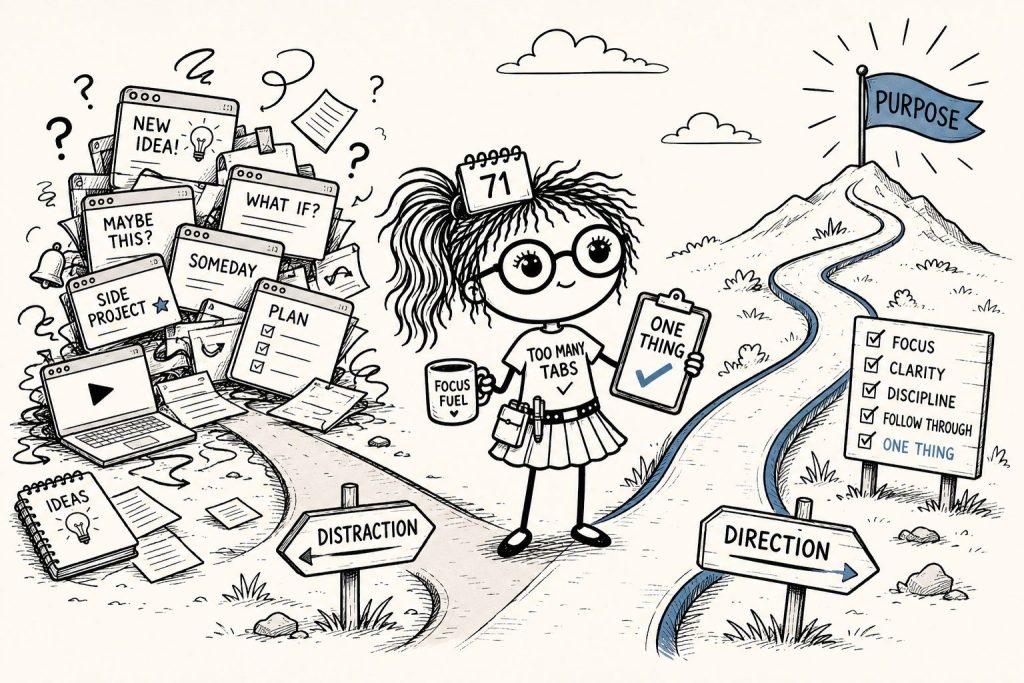
It is usually one of a small number of specific patterns: a research loop that never closes, a self-trust gap that keeps reopening, too many tabs competing for the same attention, or a direction that keeps getting buried under what feels more responsible or more certain.
The quiz will tell you which one is running the show for you.
Seven questions. Specific results. A cleaner read on what is actually between you and the clarity you have been looking for.
It takes less time than another round of preparation.
And it is a decision, not a feeling.
Which, as it turns out, is exactly the point.