
Make the career decision you keep reopening.
You have researched the jobs, saved the courses, and talked yourself into and out of the same move.
Every time you get close to choosing, another doubt sends you back to the beginning. You want a decision you can stand behind, with your income and responsibilities accounted for.
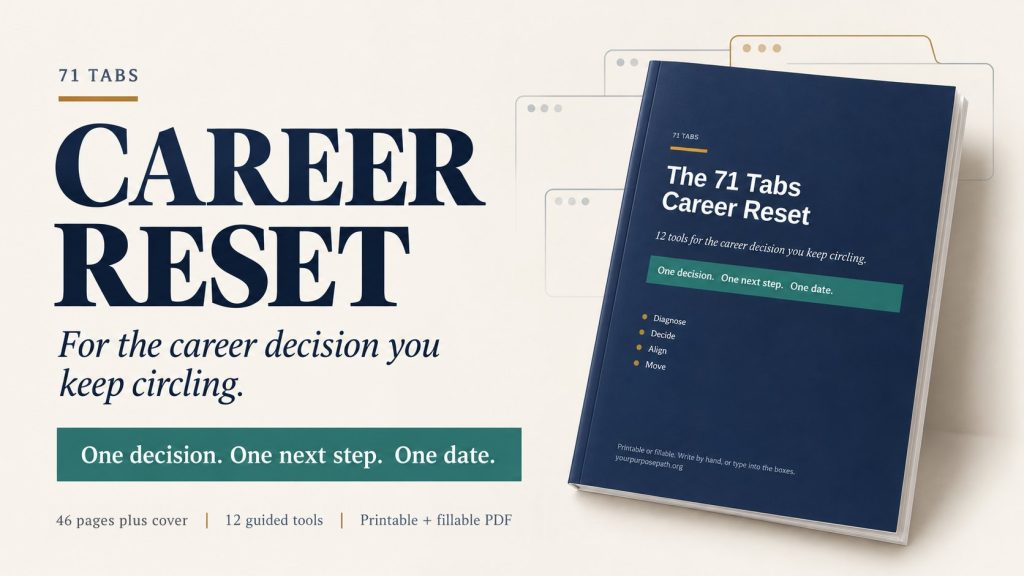
The 71 Tabs Career Reset helps you examine that decision and put a practical next move on paper.
One decision. One next step. One date.
There is a lot riding on this decision.
You want work that fits the life you have now. You also need to account for your income, your time, and the people who depend on you.
Can I afford to change? Am I too late? What if I pay for training and discover I dislike the work? What if I stay and have this exact conversation with myself next year?
You may already have a direction that keeps returning. The difficult part is trusting your judgment enough to do something with it.
“Follow your passion” sounds lovely. Your bills are still in the corner making eye contact.
This workbook helps you check the practical realities, separate the questions that need facts from those that need a small test, and choose what happens next.
See how a career question becomes a next move.
Illustrative worked example from the workbook.A teacher has fourteen years of experience, including eight working part-time while the children were young. Four directions keep competing for attention.
The Stay, Quit, Pivot Filter checks income and practical feasibility before comparing fit.
| Option | Income requirement | Practical feasibility | Fit score |
|---|---|---|---|
| Staying in the classroom | Meets | Meets | 9/15 |
| District curriculum role | Meets | Needs information | 10/15 |
| Instructional design | Needs information | Meets | 13/15 |
| Counseling degree | Does not meet | Does not meet | Not scored |
Instructional design has the highest fit score. Before treating it as a full career move, the teacher needs to check realistic starting pay.
The counseling degree does not meet the current requirements, so it becomes a later possibility.
The next decision is to test instructional design while keeping the teaching job.
Here is the next move plan.
- Decision
- Test whether instructional design is a realistic next direction while keeping the current job.
- First fourteen days
- Create one sample training module, speak with two instructional designers, and review five current job descriptions.
- Days fifteen to thirty
- Use what was learned to choose the next action: apply to roles, take one relevant course, or stop the test.
- Success measure
- Find out whether the daily work still interests me after firsthand experience, and what the income transition would require.
- Review
- At the end of the thirty-day step, decide whether to continue, adjust, pause, or stop.
That is the kind of output you are working toward: a decision tied to your circumstances, a specific action, and a date for examining what you learn.
Make a choice you can return to when the doubts show up.
The workbook helps you:
- Check your financial requirements before committing to a direction.
- Identify whose expectations and approval are influencing the choice.
- Match the move to the time and energy you actually have.
- Name the facts you still need and choose a small test where experience would help.
- Write down what you decided, why, and when you will review it.
The Next Move Plan also includes a place for the “72nd tab”: the new, exciting option that appears halfway through your plan.
Capture it on the parking list and return to it at your review date. A new idea can have a place without taking over the current decision.
Start with the track that fits your situation.
Open Find Your Track and follow the suggested tools. The shortest route uses four.
There are routes for people who keep researching, want someone else’s approval, keep starting and switching, compare themselves with others, or feel too depleted to tell what needs to change.
Every route includes the Season and Capacity Check and finishes with the Next Move Plan.
Your decision might be to test a direction, change jobs, stay with one condition changed, schedule a later review, or release an option.
Inside your download
- A printable and fillable PDF, 46 pages plus cover.
- Twelve guided tools with space for your answers.
- Suggested tracks and a four-tool shortest route.
- A completed comparison and worked next move plan.
- A 14-day evidence plan.
- A structure for your next thirty-day step and review.
- Immediate access after purchase.
Explore the twelve tools
Stage 1Diagnose3 tools
- The Career Noise Audit
- The Career Option Filter
- The Borrowed Career Voice Map
Stage 2Decide3 tools
- The Want, Know, Fear Career Tracker
- The Stay, Quit, Pivot Filter
- The 5-Why Career Stuck Test
Stage 3Align4 tools
- The Work Energy Audit
- The Work Fit Compass
- The Season and Capacity Check
- The Tab Tax Invoice
Stage 4Move2 tools
- The 14-Day Career Evidence Plan
- The Next Move Plan
FAQ
How is this different from the assessments and workbooks I already own?
This workbook stays with one career decision. You compare actual options, check income and feasibility, examine your capacity, and write a next move with dates. The examples above show the method so you can judge whether it addresses what has been missing for you.
What if I already know which direction interests me?
Find Your Track includes a route for people who know the direction but keep waiting for permission or questioning themselves. The work helps you examine the objections, check the practical requirements, and choose a manageable test.
What if I do not have the energy for another big project?
The shortest route uses four tools. You can complete one at a time. The capacity check also helps you decide how much this season can realistically hold.
What will I have written down when I finish my track?
Your decision, a specific next step, start and end dates, the obstacle most likely to interrupt you, and how you will review what happened.
Do I have to leave my job?
Staying on purpose, changing one condition, or scheduling a later review are valid decisions within the workbook. The process includes your financial needs and current responsibilities.
Can I type into it?
Yes. The PDF has fillable answer boxes. You can also print it and write by hand.
How do I receive it?
Gumroad provides the PDF immediately after purchase. It is a one-time $37 purchase.
Put your next career move on the calendar.
Before you pay for another course or spend another month reopening the same question, work through the decision you are actually facing.
Choose your track. Examine the facts and constraints. Write your decision and give the next step a date.
The 71 Tabs Career Reset
- Printable and fillable PDF, 46 pages plus cover
- 12 guided tools
- $37, one-time purchase