
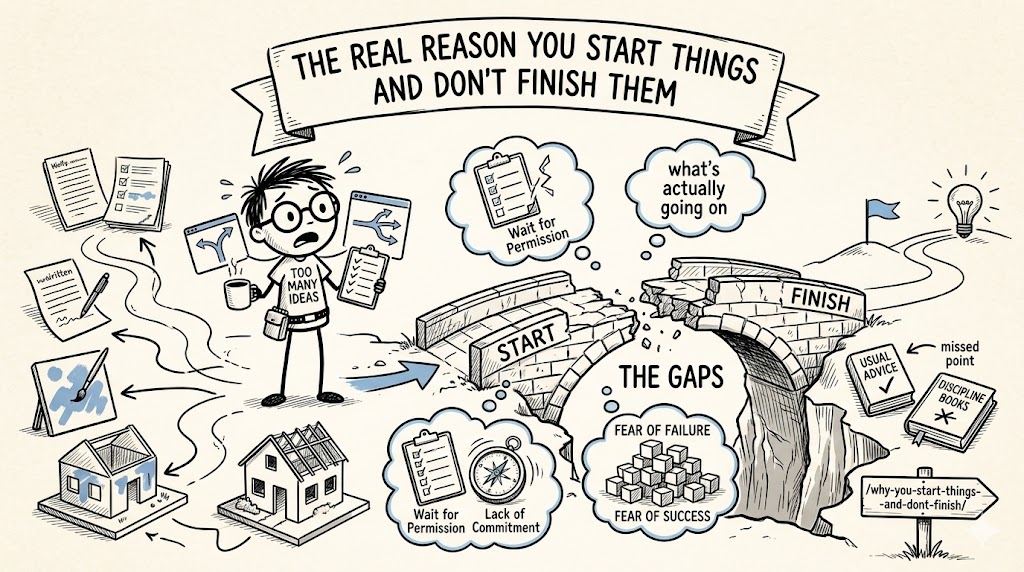
You are not lazy.
Let’s just get that out of the way first.
Lazy people do not start things. You start things all the time. You have a whole graveyard of started things. The half-read books. The courses you bought and opened once. The business idea with a name and a logo and zero customers. The journal with four enthusiastic entries from fourteen months ago. The project that was going really well until it suddenly wasn’t.
Lazy is not the problem.
So what is?
Because you have tried the solutions for lazy and they have not worked. You have set alarms. Made schedules. Told people about your goals so you would feel accountable. Downloaded apps. Bought planners that were definitely going to be the one. Watched motivational content until your situational confidence was sky-high and your follow-through was exactly the same as before.
Nothing stuck.
And at some point you started wondering if the problem was you. Not what you were doing. You.
It is not you.
It is the diagnosis.
The Wrong Explanation Is Keeping You Stuck
The most common explanations for starting without finishing are discipline, motivation, and time.
You lack discipline. You need more motivation. You do not have enough time.
These explanations feel true because they are partially true.
But partial truth is the most dangerous kind, because it sends you off solving the wrong problem with a lot of effort and very little result.
Here is what those explanations miss.
Discipline does not fail on things you actually care about finishing. You finish what you finish. You do not forget to eat. You do not forget to check your phone. You do not abandon the things that are genuinely connected to something that matters to you.
Motivation does not run out on things that are properly aligned. Motivation is inconsistent, yes. But the projects that keep getting returned to, the ideas that keep showing up even after you have talked yourself out of them — those have something underneath them that is stronger than motivation.
Time does not disappear for things you have actually decided to prioritize. Everyone who has ever reorganized their schedule around something that mattered to them knows this. Time exists. You find it for what is real.
So if discipline, motivation, and time are not the root problem, what is?
What Is Actually Happening
There are three real reasons capable people start things and do not finish them.
Not ten. Not a listicle. Three.
1. You started the wrong thing.
Not wrong because it was a bad idea.
Wrong because it was someone else’s version of the right idea.
You started what looked good from the outside. What made sense on paper. What someone you respect was doing. What seemed practical, strategic, responsible, or impressive enough to justify the effort.
But underneath the reasonable logic, it was never really yours.
And your brain knows the difference between genuine direction and dressed-up obligation, even when your mouth has already committed.
So you start. The initial energy carries you for a while. And then one day you sit down to work on it and there is nothing there. Not resistance, exactly. More like absence. Like trying to start a car that has no engine.
That absence is information.
It is not laziness. It is misalignment.
2. You never actually decided.
Starting something and deciding to finish it are two completely different acts.
Most people conflate them. They assume that beginning means deciding. It does not.
Starting is exciting. Starting is low-risk. Starting carries the energy of possibility without the weight of commitment. You are not failing yet. You have not closed any other doors yet. The thing still has the soft glow of potential.
Deciding is different.
Deciding means this is the thing. Not one of the things. Not the thing I am exploring right now. The thing I am choosing to see through, past the point where it stops being exciting and starts being just work.
Most people never make that second decision.
They start. They enjoy the beginning. They hit the part where it requires consistency without reward. And because they never actually committed to finishing, stopping does not feel like quitting. It feels like reassessing.
It is quitting. But it wears a more sophisticated outfit.
3. The finish line is too far away and too vague.
This one is structural, not psychological.
Your brain needs to be able to see progress.
Not progress in ten months. Progress this week. Preferably today. Not because you are impatient or undisciplined but because your brain is a biological system that runs on feedback, and feedback requires proximity.
When the goal is large, distant, and defined by a single moment of completion somewhere in the future, your brain does not get the signals it needs to stay engaged. So it starts looking for something that will give it what it needs.
Something new. Something with fresh possibility. Something that feels like progress because at least it is moving, even if it is moving in a different direction entirely.
And the cycle starts again.
Why the Standard Advice Makes It Worse
More accountability does not fix misalignment. It just makes you feel worse about abandoning something that was never right for you.
More motivation content does not fix an undecided commitment. It inflates the starting energy again, which gets you back to the same wall faster.
More planning does not fix a finish line that is structurally too far away. It adds more detail to a goal that is still not producing the feedback your brain needs.
None of these are wrong in general.
They are wrong as solutions to the actual problem.
The Question That Changes Things
Before you try another system, another strategy, another accountability partner, or another planner with motivational quotes in the margins, answer this honestly.
Did you actually decide to finish this?
Not start it. Decide to finish it.
There is a moment in every real commitment where you cross a line from “I am trying this” to “I am doing this.” That line is not dramatic. It is not always visible from the outside. But internally, it is the difference between a thing you are exploring and a thing you have claimed as yours to complete.
If you have not crossed that line, no system is going to carry you across it.
The decision comes first.
The tools come after.
What You Actually Need to Sort Out
There are usually one of two things going on when the starting-without-finishing pattern is running your life.
Either you are starting things that are not genuinely yours to build, which is an alignment problem.
Or you are starting things that are genuinely yours but abandoning them before they get hard, which is a self-trust and commitment problem.
Both are real. Both are fixable.
But they need different solutions.
And the worst thing you can do is grab a solution for one when you are actually dealing with the other.
If you want to know which pattern is running for you specifically, take the quiz. It takes seven questions to diagnose what is actually keeping you stuck, because starting without finishing is almost never just one thing. The pattern has a source, and the source is specific to you.
That is where the fix actually starts.
Not with a better planner.
Not with more willpower.
With an honest read on what is actually going on underneath the pattern.
Seven questions. Uncomfortably accurate.
Start there.
You cannot solve what you have not named.
Why You’re Still Stuck (It’s Not What You Think)
7 questions. Uncomfortably accurate. This is not a personality quiz. It is a diagnosis.
TAKE THE QUIZ →