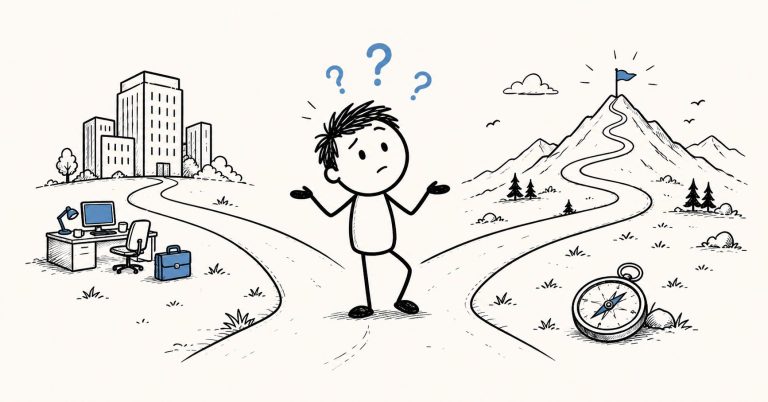
You have done the research.
You have read the articles, watched the videos, taken the quizzes, listened to the podcast episodes, filled out the worksheets, made the pros and cons list, remade the pros and cons list because the first one felt incomplete, and asked at least three people whose opinions you respect what they think you should do.
And you still have not decided.
So you open another tab.
Here is the uncomfortable truth that nobody putting out research-friendly content is going to tell you: at a certain point, more research is not the path to a decision. More research is the delay wearing a responsible disguise. You are not stuck because you lack information. You are stuck because you do not yet trust yourself enough to act on the information you already have.
That is a different problem. And it needs a different solution.
Why Smart People Are the Most Likely to Fall Into This Trap
The research loop is particularly cruel to intelligent people because it feels so legitimate.
You are not procrastinating. You are preparing. You are not avoiding. You are being thorough. You are gathering data, considering angles, weighing options. From the outside, you look responsible. From the inside, you know the decision is not getting any closer.
This is what makes the loop so hard to break. It does not feel like avoidance. Avoidance feels like scrolling social media for two hours when you were supposed to be working. This feels like work. It looks like diligence. Your brain rewards you for it because your brain genuinely cannot tell the difference between productive preparation and sophisticated stalling.
But here is the tell: if you have had enough information to make a reasonable decision for weeks or months and you still have not made it, you are not missing data. You are missing trust.
The research is not building your confidence. It is feeding the belief that confidence is something you can think your way into. You cannot. Confidence is not the thing that comes before you act. It is the thing that builds as a result of acting. Which means no amount of additional research is ever going to produce the feeling you are waiting for before you commit.
The finish line keeps moving because the finish line was never real.
What You Are Actually Waiting For
Let’s name it clearly.
When you cannot make a decision despite having more than enough information, you are usually waiting for one of three things.
Certainty. You want to know, before you commit, that you are making the right choice. You want to eliminate the possibility of regret. You want a guarantee that this will work, that you will not look foolish, that you will not have to reverse course later. That guarantee does not exist. For any decision worth making, certainty is not available in advance. It is only available in hindsight, after you have already moved.
Permission. You want someone whose opinion you trust to tell you that your instinct is correct. A mentor, a friend, a partner, a parent, a stranger on a forum who seems to have figured it out. You are not looking for new information from these people. You are looking for confirmation of what you already sense to be true. Which means the issue is not that you do not know. The issue is that you do not yet trust what you know.
The feeling of readiness. You are waiting to feel ready. Ready enough, prepared enough, confident enough, clear enough. Ready is a feeling you are waiting to arrive before you act. But for most meaningful decisions, readiness is not a pre-condition. It is a side effect of moving. You do not feel ready and then start. You start, and then you feel ready. Usually about ten steps in, after it is too late to turn back comfortably. That is not a design flaw. That is how it works.
None of these three things can be found in another article. Not even this one.
The Research Loop: How It Actually Works
Understanding the mechanics helps. Here is the loop in plain language.
You face a decision. The decision matters to you, which means it carries some risk. Risk triggers discomfort. Discomfort triggers avoidance. But you are not the kind of person who just avoids things, so your brain offers a more sophisticated option: keep researching. Researching feels productive. It reduces the immediate discomfort. It gives you something to do that looks like progress. So you research.
But research does not reduce the actual risk. It reduces the felt discomfort just enough to stay in the loop. So you feel slightly better. Not better enough to decide, just better enough to keep going. You find one more angle that needs consideration. One more question that needs answering. One more person worth consulting.
The loop sustains itself because it works on its own terms. It is genuinely good at relieving momentary discomfort. What it cannot do is deliver you out the other side into a decision. Because the discomfort was never really about lacking information. It was about lacking trust in your own judgment. And research does not build that. Only action does.
Why This Is a Self-Trust Problem, Not an Information Problem
Here is the distinction that changes everything.
If your inability to decide was an information problem, additional research would solve it. You would reach a point where the research gave you what you needed and the decision would become clear. That is not what happens. What happens instead is that the more you research, the more complexity you find, the more angles you uncover, and the further the decision feels.
That is because you are not actually solving for information. You are solving for safety. And the safety you are looking for is not located in the research. It is located in your relationship with your own judgment.
Somewhere along the way, you learned that your instincts are not quite reliable enough to trust on their own. Maybe a decision you were certain about did not work out the way you expected. Maybe you were raised in a system that rewarded checking with others before committing. Maybe you have been wrong before in a way that cost you, and your brain has been protecting you from that specific pain ever since.
Whatever the origin, the result is the same. You second-guess the thing you already know. You hold your own discernment at arm’s length and go looking for something more authoritative. The research is that something. It feels more objective, more reliable, more defensible than your own gut reading. But it is not more accurate. It is just louder.
Your instincts have been right more often than you credit them. You just do not keep score that way.
The Question That Breaks the Loop
There is one question that cuts through the research loop faster than anything else, and most people never ask it.
Not “what does the research say?”
Not “what do other people think I should do?”
Not “what is the safest option?”
The question is: What do I already know that I keep refusing to count?
Sit with that.
Because most people who are stuck in a research loop already know the answer. Not with perfect certainty, not without risk, not in a way they could defend to a skeptical audience. But they know. There is a direction that keeps returning. A choice that feels more like theirs than the alternatives. An answer they have talked themselves out of more than once because it felt premature, or risky, or like too much to explain.
That answer is not a feeling to be dismissed. It is data. It is your accumulated experience, your values, your pattern recognition, and your actual life all pointing in the same direction. It counts. Even when it is inconvenient. Even when it is not yet defensible. Even when you are not fully ready.
What do you already know?
Write it down. Not as a draft, not as a commitment, just as an honest answer to that one question. What you write in the next two minutes will probably tell you more than the next two weeks of research.
How to Actually Move Forward
The exit from the research loop is not more information. It is a smaller action than you think.
Stop researching before you feel ready. This is the hardest step and also the most important one. Set a research deadline. Not an arbitrary one, but an honest one based on what you actually need versus what you are using to delay. Give yourself until a specific date, and then stop collecting and start deciding. The information you have at the deadline is the information you decide with.
Name the real risk. Most research loops are protecting against one specific fear, not a general lack of information. Name it. What is the actual thing you are afraid will happen if you decide and it turns out to be wrong? Write it plainly. Most of the time, when the fear is named clearly, it is more manageable than the vague dread that keeps driving the research. You are not afraid of the decision. You are afraid of one specific outcome. Those are different problems with different solutions.
Take the smallest action that constitutes a real decision. Not the full commitment. Not the announcement. Not the point of no return. Just the smallest action that is more than research. A conversation. An application. An email. A registration. Something that exists in reality rather than exclusively in your head. Reality gives feedback. Your head gives loops.
Track where your judgment has been right. Seriously. Keep a running list. Every time your instinct was correct, write it down. Not to build arrogance, but to build evidence. Self-trust does not grow from inspiration. It grows from evidence that your judgment can handle reality. You have more of that evidence than you are currently counting.
If you want a structured way to run this process, the Stay Quit Pivot Filter is a clean starting point. It is a five-question diagnostic built specifically for the moment when you know something needs to change but you cannot quite commit to the next step. It will not make the decision for you. But it will help you get honest about what is actually driving the delay.
The Cost of Staying in the Loop
One more thing worth naming directly.
Sustained indecision is not neutral. It does not just mean the decision has not been made yet. It has real costs that accumulate while you are researching.
Time passes. Options close. Momentum never builds. Other people move into the spaces you were considering. The window for a particular move shrinks. And perhaps most importantly, every week you spend in the research loop instead of deciding is another week of evidence to your brain that you cannot trust yourself to commit. The loop does not just delay the decision. It deepens the pattern.
You are not just waiting. You are practicing waiting. And every practice session makes the next one easier.
The longer you stay in the loop, the more natural the loop becomes. And the more natural it becomes, the harder it is to recognize it as avoidance rather than preparation.
The decision you are currently researching probably does not require more information. If you are honest with yourself for thirty seconds, you already know that. What it requires is a choice, made without perfect certainty, by someone who has decided to trust her own judgment enough to move.
That someone is you. She has been ready longer than you have been willing to admit.
What Kind of Stuck Are You?
The research loop is one of five distinct patterns that keep capable people from moving forward. They look similar from the outside. They need different solutions on the inside.
If you want to know which one is actually driving your indecision, take the quiz. Seven questions, five possible results, and the kind of specific diagnosis that explains why everything you have tried so far has not quite worked.
Because the problem is almost never what it looks like on the surface.
And the solution is almost never more research.
Before you quit, stay, enroll, pivot, or spend another year circling the same decision.
Get the Free Stay, Quit, Pivot Filter
If your career decision keeps looping in your head, the problem may not be lack of information. You may need a cleaner way to compare your real options.
The Stay, Quit, Pivot Filter is a free 20-minute career decision tool that helps you score your options against six honest criteria: energy fit, income reality, identity alignment, practical feasibility, concern validity, and gut response.
No quiz. No personality type. No fluffy “follow your dreams” speech. Just your actual options, evaluated honestly.
Send Me the Free Career FilterTakes about 20 minutes. Gives you a real starting point.