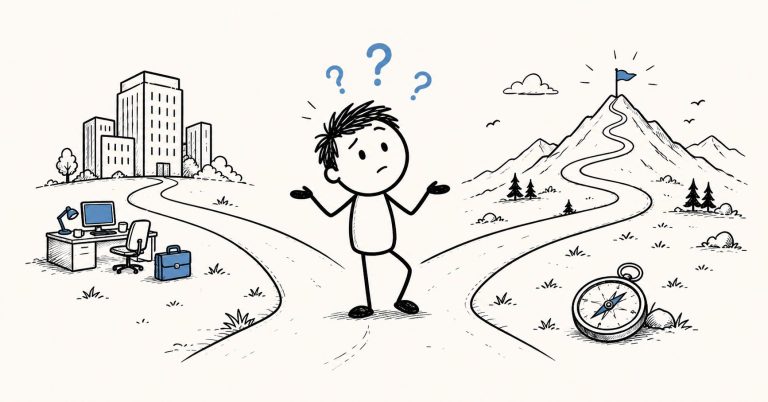

You have two options.
You have thought about both of them more times than is medically advisable.
You made the list. You weighed the factors. You imagined both futures. You asked people. You prayed about it. You journaled until your hand cramped. You slept on it, which is what people say when they mean they stared at the ceiling for two hours and then woke up feeling worse.
And both options still feel wrong.
Not uncertain. Not risky.
Wrong.
Like neither one is the actual answer and the universe accidentally gave you the wrong decision to make.
So you stay stuck.
And the longer you stay stuck, the worse both options look, which makes staying stuck feel more justified, which keeps you exactly where you are.
That is not a decision problem.
That is a loop.
And there is a way out. But it requires getting honest about something most people skip entirely.
Why Both Options Feel Wrong
The first thing people assume is that the options are the problem.
Maybe there is a third option hiding somewhere. Maybe they have not researched hard enough. Maybe both options are genuinely bad and the real answer is to wait for something better to appear.
Sometimes that is true.
Most of the time, it is not.
Here is what is usually actually happening.
You are comparing real options to an imaginary one.
Every real choice comes with tradeoffs.
Every real option has a downside.
Every real path closes other paths.
But somewhere in the middle of the decision spiral, your brain quietly drafted the ideal version of what the right choice should feel like.
The right choice would be exciting and safe. Obviously correct. It would not require giving anything up. It would feel like relief, not risk. You would know immediately. The path would be clear. Someone wise would nod approvingly.
That choice does not exist.
The actual choices in front of you are real, which means they are messier, less certain, and require you to commit to something while knowing you might be wrong.
When both real options feel wrong, it is often because you are measuring them against an option that only exists in your imagination.
Your real choices were never going to win that competition.
You are feeling the loss that comes with choosing, not a problem with the options.
Every decision is also a loss.
Choose Option A, and you lose Option B.
Choose to stay, and you lose what leaving might have become.
Choose the new direction, and you lose the familiarity of the old one.
Most people do not frame it that way, but that is what is happening underneath the analysis. And for people who feel things deeply, that loss makes any choice feel wrong before it has even been made.
The discomfort is not a signal that the options are bad.
It is a signal that commitment costs something.
That is true regardless of how good the option is.
You have been in this decision too long.
There is a specific kind of wrongness that sets in after months of circling the same two choices.
Downsides get amplified. Upsides start looking suspicious. Every new piece of information gets filtered through a brain that has been in decision-fatigue mode long enough to find a problem with everything.
If you have been sitting with this decision for a long time and both options feel wrong, the wrongness you are feeling may have less to do with the quality of the options and more to do with the exhaustion of staring at them.
You have looked at these two things so long they have lost their shape.
That happens with words too, if you stare at them long enough.
It does not mean the word is wrong.
It means you need to blink and decide.
The Question Nobody Thinks to Ask
When both options feel wrong, most people ask: what is the right choice?
Useless question at this stage.
The more useful question is: what is the actual cost of not choosing?
Not the cost of choosing wrong. The cost of choosing nothing.
Staying stuck feels neutral. It does not feel like a decision. It feels like waiting for clarity, or the right moment, or a sign that is clear enough to count.
But staying stuck is a decision.
It has consequences that accumulate quietly while you are waiting.
Another year in the wrong role. Another year not building the thing. Another year of low-grade dissatisfaction you have gotten so good at managing it barely registers. Another year watching the same window and wondering if it is still open.
The cost of not deciding is real.
It is just quieter than the cost of choosing wrong, so it keeps getting left off the list.
Put it back on the list.
What “Both Options Feel Wrong” Is Usually Telling You
Not always. But usually.
You already know which one you are going to choose.
You know.
You have probably known for a while.
But the option you are leaning toward has something uncomfortable attached to it. A conversation you need to have. A door you will have to close. A version of yourself you will have to leave behind. An admission you are not quite ready to make.
So instead of choosing it and dealing with those things, you keep the decision open.
Both options stay on the table. You keep analyzing. Neither one feels right, technically, because the one you actually want comes at a cost you are not yet ready to pay.
This is not a decision problem.
This is a follow-through problem.
The decision is essentially made. You are managing the feelings that come with owning it.
Neither option is actually solving the real problem.
Sometimes when both options feel wrong, it is because you are solving the wrong problem.
You are choosing between Job A and Job B when the real question is whether you want to stay in this field at all.
You are deciding whether to stay or leave when the real question is whether you have gotten honest about what you actually need.
You are choosing between two directions when neither of them has been tested and you are comparing speculation to speculation.
When the real issue has not been named, no option will feel right.
Because the options are downstream of the actual problem, and you have not gone upstream yet.
Before you force a choice between two things that both feel wrong, ask whether you are solving the right problem.
How to Actually Move Through This
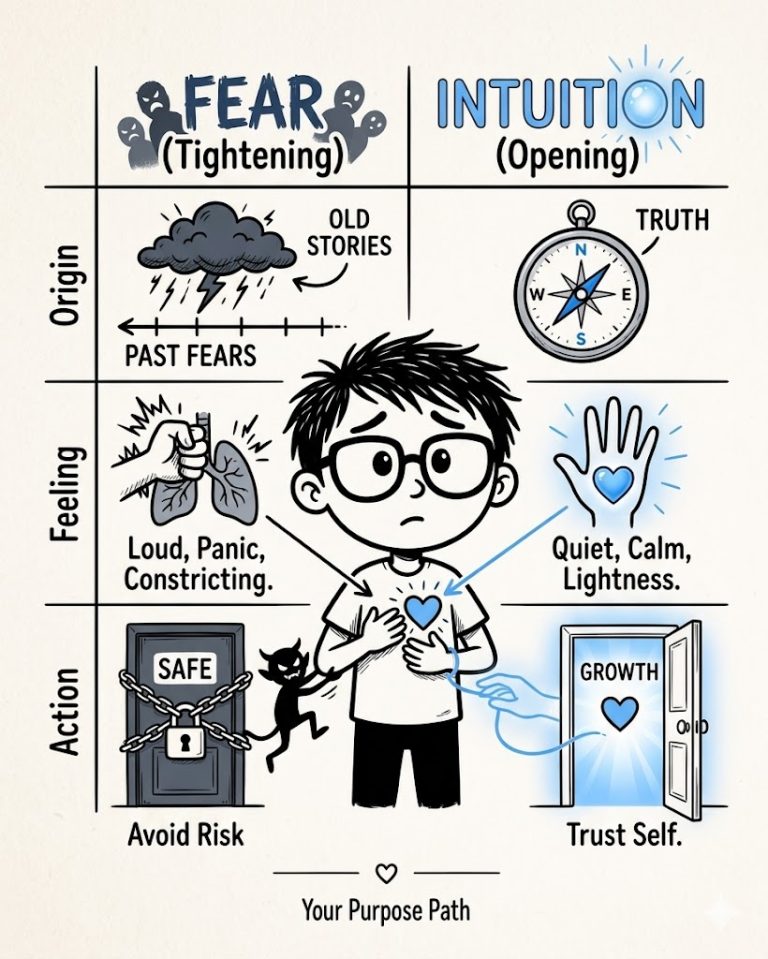
Separate the discomfort from the wrongness.
These are not the same thing.
A decision can feel uncomfortable and still be right.
Most good decisions involving real change feel uncomfortable before they feel right. The discomfort is the cost of the tradeoff. It is not a red flag. It is the price tag.
For each option, write down what specifically feels wrong about it.
Not vague wrongness. The actual thing.
What would you lose? What would be hard? What are you afraid of?
Then look at your list honestly.
Is what feels wrong actually a flaw in the option?
Or is it the discomfort of commitment, loss, or change?
One tells you the option is a bad fit.
The other tells you the option is real.
Real options cost something. That is not a disqualifier. That is just how this works.
Test both options against what you actually need, not what would be perfect.
Get specific about what you need from this decision.
Not what would be ideal in a world where tradeoffs do not exist.
What do you actually need most, right now, given your real life and not the one you planned at twenty-three?
Pick your top two or three needs. Stability. Growth. Alignment. Flexibility. Income. Autonomy. Impact. Whatever actually matters most to you in this season.
Run both options against those needs only.
Most of the time, one option serves your actual priorities better than the other.
The reason it did not feel obviously right is that it does not serve the lower-priority items as well, and you have been treating everything as equally important.
Most of it is not equally important.
You have preferences dressed up as dealbreakers.
Ask the regret question differently.
The standard version is: which option will I regret more?
That question is almost impossible to answer cleanly because your brain will generate convincing regret scenarios for both options and you will end up exactly where you started.
Try this instead.
Ten years from now, which type of regret will be harder to live with?
Regretting that you tried something and it did not work out the way you hoped?
Or regretting that you never tried at all?
For most people, that answer is not actually complicated.
The regret of inaction follows you differently than the regret of action. A decision that did not work out is a chapter with a lesson in it. A decision that was never made is a question that never closes.
Set a real deadline and make the call.
At some point the decision has to be made with the information you have.
Not when both options feel right. They may never both feel right.
Not when you feel ready. Ready is not a precondition. It is a side effect of deciding.
Pick a date. A specific one. Not “by end of month” which is how people say “probably never.”
On that date, you choose with what you know. You accept that you are choosing imperfectly because all real choices are imperfect. And you move.
This is not recklessness.
This is the recognition that sustained indecision is a decision, and it is almost never the best one available to you.
One Thing Worth Knowing About Hard Decisions
Most decisions that feel impossible look much more manageable from the other side.
Not because they turned out to be easy.
Some of them were hard. Some had real costs. Some required adjustment and a new plan.
But from the other side, the decision itself is no longer the weight.
You are either building something from your choice, or you are course-correcting based on real information instead of imagined outcomes.
Either way, you are moving.
The paralysis is heavier than most of the consequences.
The waiting costs more than being wrong.
Both options feel wrong because you have been staring at them so long they have lost their shape.
Pick one.
Move.
See what the ground feels like under your feet.
It is almost always more solid than the loop made it seem.
If You Are Still Not Sure Which Pattern Is Driving This
Sometimes a decision feels impossible because of the options themselves.
More often it is something underneath: a research loop that never closes, a self-trust gap that reopens every time you get close to committing, a fear of judgment that shows up every time the stakes feel real.
The clarity quiz takes seven questions to tell you which pattern is actually running the show.
Five results. Specific. Worth knowing before you spend another month going in circles.

Before you quit, stay, enroll, pivot, or spend another year circling the same decision.
Get the Free Stay, Quit, Pivot Filter
If your career decision keeps looping in your head, the problem may not be lack of information. You may need a cleaner way to compare your real options.
The Stay, Quit, Pivot Filter is a free 20-minute career decision tool that helps you score your options against six honest criteria: energy fit, income reality, identity alignment, practical feasibility, concern validity, and gut response.
No quiz. No personality type. No fluffy “follow your dreams” speech. Just your actual options, evaluated honestly.
Send Me the Free Career FilterTakes about 20 minutes. Gives you a real starting point.