Stop optimizing nonsense.
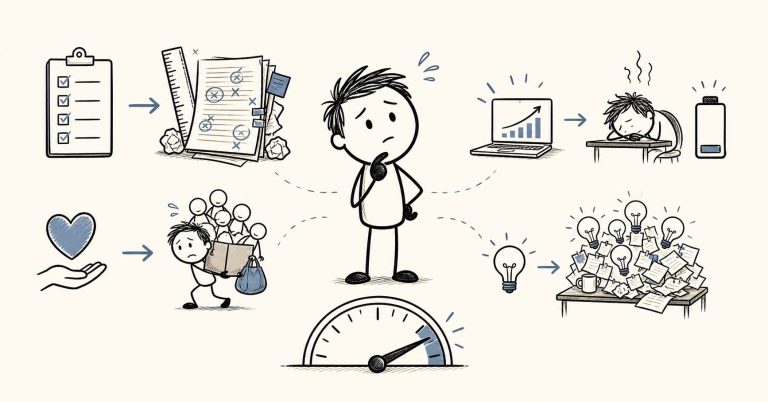
Some people do not have a motivation problem.
They have a complexity problem.
They build too much. Add too much. Tweak too much. Then wonder why nothing is moving.
Elon Musk is known for a five-step process for improving systems: question every requirement, delete what you can, simplify what remains, accelerate cycle time, and automate last. The key is the order. His argument is that most people optimize and automate too early, which means they make bad systems faster instead of making them better.
That is not just a factory problem.
That is an overwhelmed-person problem.
A business problem.
A life problem.
A lot of people are out here making the mess more efficient instead of making it smaller.
1. Question every requirement
Before you improve anything, ask a better question:
Why does this exist?
Who said this has to be part of the process?
Is this actually necessary, or did I just inherit it from other people?
A surprising amount of what people call “strategy” is just unchallenged assumptions with decent branding.
2. Delete
This is where things get real.
Delete steps.
Delete clutter.
Delete busywork.
Delete the parts that make you feel productive without actually moving anything forward.
Most people do not need a better system for managing everything.
They need fewer things to manage.
That is not failure. That is intelligence.
3. Simplify
Now simplify what is left.
Not before deleting. After.
Because cleaning up something unnecessary is still wasted effort.
Simplifying means keeping the main thing the main thing. One goal. One path. One next step. Not six “important” priorities fighting each other in your head like toddlers with Wi-Fi.
4. Accelerate cycle time
Once the system is cleaner, then speed matters.
Test faster.
Decide faster.
Get feedback faster.
Not because rushing is wise, but because endless thinking is not proof of wisdom either.
A lot of people confuse delay with discernment. They are not the same.
5. Automate last
This part is important.
Do not automate a bad process.
Do not build fancy systems around something that is still unclear, bloated, or ineffective.
Automation is not magic. It is multiplication.
If the system is bad, automation just helps it fail with more confidence. Musk has also said Tesla made mistakes by trying to automate too early.
What this means in real life
If you are overwhelmed, the answer is usually not more tools, more planning, or more optimization.
It is usually:
Question what you are doing
Cut what does not belong
Simplify what remains
Move faster once it is clean
Automate only after it works
In other words: stop building a better machine for nonsense.
That goes for your work, your routines, your goals, and the weird personal bureaucracy you created around one decision you should have made three months ago.
Final thought
A lot of smart people stay stuck because they keep improving things that should have been questioned, reduced, or removed first.
They optimize before they decide.
They automate before they simplify.
They stay busy instead of getting clear.
Do not make the mess prettier.
Make it smaller.
That is usually where progress starts.
You cannot solve what you have not named.
Why You’re Still Stuck (It’s Not What You Think)
7 questions. Uncomfortably accurate. This is not a personality quiz. It is a diagnosis.
TAKE THE QUIZ →