
If you hate your job but can’t afford to quit, you do not need a motivational quote.
You need a plan.
“Just leave” sounds brave until rent, groceries, kids, health insurance, debt, and reality walk into the room carrying clipboards.
So no, this is not going to be one of those articles telling you to follow your passion and leap.
Leap where?
Into overdraft?
Please.
If your job is draining you but your paycheck is still holding your life together, the goal is not panic. The goal is a bridge.
You do not have to pretend everything is fine. You also do not have to blow up your life because you are tired, angry, underpaid, overlooked, burned out, or two emails away from sending a resignation letter with no punctuation.
There is a middle option.
You can plan a career reset without making a reckless move.
If You Hate Your Job But Can’t Afford to Quit, Start Here
First, stop shaming yourself for staying.
People love to talk about quitting like it is always the brave move. Sometimes it is. Sometimes quitting is necessary, wise, overdue, and healthier than staying one more month in a place that is draining the life out of you.
But sometimes staying for now is not cowardice.
Sometimes it is math.
Bills are real. Health insurance is real. Kids are real. Debt is real. Groceries are extremely real, especially now that one bag of ordinary food somehow costs $83 and a small piece of your soul.
So if you cannot quit today, that does not mean you are weak. It means you need a strategy that respects your actual life.
The question is not, “Why can’t I just leave?”
The better question is: How do I build a bridge out without wrecking the parts of my life this paycheck is holding together?
That gives your brain something useful to work with.
Why “Just Quit” Is Usually Bad Advice
“Just quit” is easy advice to give when you are not the one paying the bills.
It sounds bold. It sounds clean. It sounds like something that belongs on a mug, a podcast clip, or a social media post from someone whose backup plan has a backup plan.
But for many people, quitting without a plan creates a second crisis on top of the first one.
Now you still have the emotional exhaustion, but you have added financial panic. A two-for-one special nobody asked for.
That does not mean you should stay forever. It means the exit needs structure.
A good exit plan protects four things:
- Your income
- Your health
- Your future options
- Your ability to think clearly
If your job is toxic, abusive, unsafe, or seriously harming your mental or physical health, you may need a faster exit and outside support. Do not try to tough-love your way through actual harm.
But if the situation is miserable, draining, or misaligned and you still need the income, the goal is not to shame yourself for staying.
The goal is to stop staying passively.
There is a difference.
Passive staying sounds like, “I hate this, but there is nothing I can do.”
Strategic staying sounds like, “I am here for now while I build the exit.”
Same job. Different posture. One drains you. The other gives you a direction.
First, Name What You Actually Hate
Before you decide what to do next, get specific.
“I hate my job” may be true, but it is too broad to be useful. It is like saying, “My house is a mess.” Fine. But are we talking dishes, laundry, mold, or a raccoon in the pantry?
Details matter.
You need to know what you actually hate because different problems need different solutions.
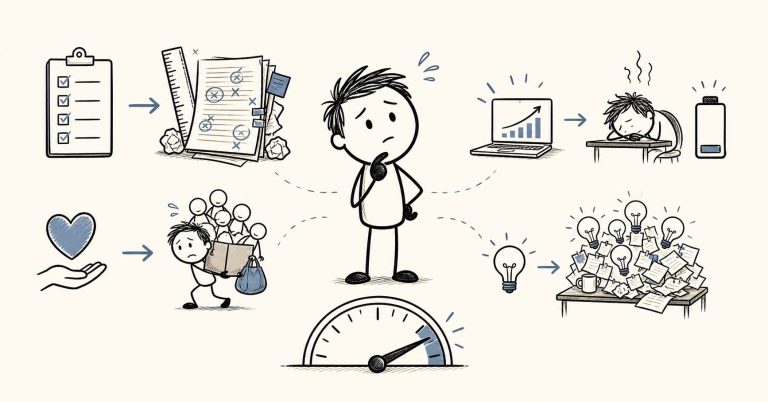
Ask yourself:
- Do I hate the actual work?
- Do I hate the workload?
- Do I hate the people?
- Do I hate the leadership?
- Do I hate the schedule?
- Do I hate the lack of growth?
- Do I hate the pay?
- Do I hate the emotional labor?
- Do I hate who I become in this environment?
- Do I hate that I have outgrown it but still feel trapped?
Those are not the same problem.
If you hate the work itself, you may need a career change. If you hate the workplace, you may need a new employer. If you hate the schedule, you may need a different structure. If you hate the pay, you may need a negotiation, a promotion, a side income, or a higher-paying path.
If you hate who you become there, pay close attention. That one matters more than the rest.
The first step is not quitting. The first step is telling the truth accurately.
Is It the Job, the Workplace, the Career, or Burnout?
When you feel trapped, everything starts to blur.
The job feels wrong. The career feels wrong. Your life feels wrong. Your email inbox feels personally hostile. Even the printer starts looking suspicious.
That is why you need to sort the problem before you make the move.
1. It May Be a Job Problem
A job problem means the specific role no longer fits.
Maybe you are bored. Maybe you are underused. Maybe the responsibilities have changed. Maybe the role uses the skills you are good at but not the ones you want to keep building.
A job problem sounds like:
“I can do this, but I do not want to keep doing this.”
“I am good at this, but it drains me.”
“I have outgrown the role.”
“I do not want my next five years to look like this.”
If that is true, you may not need a whole new career. You may need a different role that uses your strengths in a better way.
Competence is not a sentence. Just because you are good at something does not mean you are required to keep building your life around it.
2. It May Be a Workplace Problem
A workplace problem means the work may still fit, but the place is wearing you down.
Bad leadership can make meaningful work miserable. A chaotic organization can make a good career feel unbearable. A dysfunctional team can make you question your entire professional life when the real issue is that the workplace operates like a system where nothing works and nobody is allowed to say so.
Ask:
- Would I feel differently doing this work somewhere healthier?
- Have I enjoyed similar work in a different environment?
- Is the problem the field, or this organization?
- Is the work draining me, or is the dysfunction draining me?
- Would better leadership change how I feel?
If the workplace is the problem, do not throw away your whole career too quickly. You may need a cleaner environment, not a full professional identity crisis.
3. It May Be a Career Problem
A career problem runs deeper.
This is when the work itself no longer fits who you are becoming.
You may feel pulled toward different work, different people, different problems, or a different way of using your gifts. The current path technically makes sense on paper, but something in you knows it is no longer the right fit.
A career problem sounds like:
“I can do this, but I do not want this to be my whole life.”
“I keep feeling drawn toward something else.”
“I want my work to mean something different now.”
“I have changed, but my career has not caught up.”
If that is the issue, you may need a career reset. Not a dramatic bonfire. A reset. That means identifying what still has value, what needs to be released, and what direction needs testing before you make a permanent decision.
4. It May Be Burnout
Burnout can make every option look terrible.
When you are exhausted, your brain starts making extreme suggestions.
Quit today. Start over completely. Do nothing forever. Move somewhere far away where nobody can reach you by email.
Burnout is not always lying, but it is not always giving clean instructions either.
If you are depleted, you need stabilization before major decision-making. That does not mean ignore the problem. It means stop asking a burned-out brain to design your entire future in one sitting.
Ask:
- Am I physically exhausted?
- Am I emotionally numb?
- Am I angry all the time?
- Am I unable to recover after rest?
- Have I stopped caring about things I normally care about?
- Do I want a new career, or do I just want relief?
That last question matters more than it looks.
Relief is valid. But relief is not the same as direction, and confusing the two is how people end up making dramatic moves that solve the exhaustion but not the actual problem.
If you are not sure which pattern is driving your stuck feeling, take the free quiz at Your Purpose Path. It identifies exactly which thinking trap is keeping you in place and gives you something more specific to work with than “I need to figure out my life.”
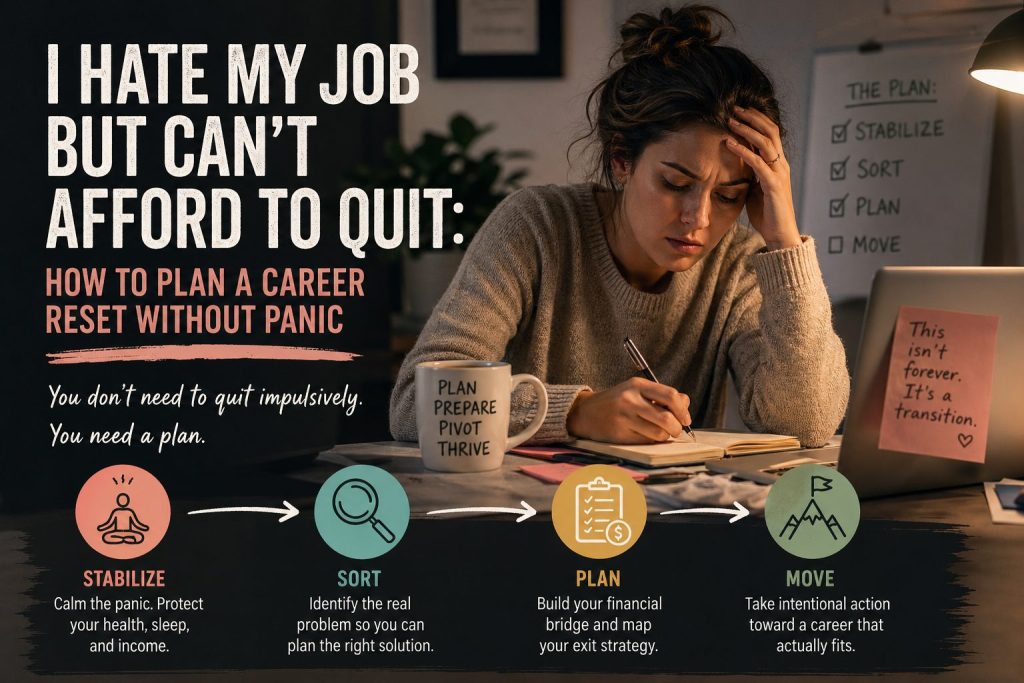
The Stabilize, Sort, Plan, Move Framework
If you hate your job but can’t afford to quit, do not start with a dramatic decision.
Start with a framework.
Use this:
- Stabilize
- Sort
- Plan
- Move
Simple. Useful. Harder to mess up when your emotions are trying to drive without a license.
Step 1: Stabilize Before You Make a Decision
When you are miserable at work, your nervous system can start treating every day like an emergency.
That makes clear thinking harder.
So before you make a big decision, stabilize what you can. This does not mean pretending the job is fine. It means reducing the amount of damage the job is doing while you build your next move. You cannot plan a clean exit while the current situation is consuming all of your energy.
Start with the basics:
- Protect your sleep as much as possible
- Stop volunteering for extra work you resent
- Take your lunch break if you can
- Use your paid time off strategically
- Set firmer boundaries around work messages after hours
- Reduce unnecessary spending while you plan
- Stop venting to people who only make you more frantic
- Get support from someone calm and practical
- Keep a written record if the workplace is unsafe, unethical, or abusive
None of this fixes the job. That is not the point. The point is to stop bleeding energy in the place you are trying to leave while you build somewhere better to go.
Stabilizing is not weakness. It is preparation.
Step 2: Sort the Real Problem
Once you have enough breathing room to think, sort the problem.
Use these questions:
What is the main thing making this job unbearable? Be specific. Not “everything.” Pick the top three.
What have I already tried? Have you asked for support, changed boundaries, requested a role adjustment, applied elsewhere, updated your resume, or talked to someone in another field?
What do I still have control over? Not total control. Realistic control.
What is outside my control? Leadership, culture, company decisions, other people’s behavior, broken systems, budget cuts, organizational nonsense.
What am I pretending not to know? This one gets uncomfortable fast.
Maybe you know the job is not sustainable. Maybe you know the workplace will not change. Maybe you know you need to leave but are afraid of the money. Maybe you know you do not want a new employer. You want a new direction entirely.
Good.
Now you are working with truth instead of fog.
Step 3: Build a Financial Bridge
If you cannot afford to quit, money needs to be part of the plan.
Not because money is everything. Because pretending money does not matter is how people end up making desperate decisions later when the timeline runs out and panic takes the wheel.
A financial bridge gives you more choices.
Start with these steps:
- Know your actual monthly expenses
- Identify what you can temporarily reduce
- Build or protect an emergency fund if possible
- Avoid taking on new debt while planning your exit
- Check your benefits and what you would lose if you left
- Research salary ranges for the roles you are considering
- Look at whether a lateral move could protect your income
- Consider temporary side income if it does not burn you out further
- Set a target date or savings number for your transition
This is not glamorous. Good. Glamour is not paying the electric bill.
The goal is to create enough financial space to move with a clear head instead of a desperate one.
A bridge strategy may look like staying three more months while applying. It may look like moving to a better workplace first, then pivoting later. It may look like building a side offer. It may look like taking a related role that pays the bills while you test the next direction.
There is no prize for making the move harder than it needs to be.
Step 4: Start Testing Your Exit Options
Do not wait until you are desperate to explore your options.
That is how people panic-apply to jobs they do not want, accept the first thing that looks less terrible, and end up six months later saying, “Why does this feel familiar?”
Because it is the same pattern in a different outfit.
Start testing now.
Testing can look like:
- Updating your resume
- Applying to five better-fit roles
- Talking to people in fields you are considering
- Shadowing or volunteering if possible
- Taking a short affordable course
- Creating a sample project
- Asking about internal transfers
- Researching salary ranges
- Building a small side offer
- Meeting with a career counselor or mentor
- Reworking your LinkedIn profile for the direction you want
The goal is to collect evidence, not solve everything at once.
You need to find out: Do I want a new job, a new workplace, or a new career? What roles would use my existing skills differently? What income range is realistic? What gaps do I need to close?
Thinking gives you theories. Testing gives you data. Data is better. Less dramatic, but significantly more useful.
Step 5: Make the Next Move Specific
If your plan is “I need to get out,” your brain will keep spinning.
That is not a plan. That is a smoke alarm. Useful for alerting you to a problem, but you cannot live in it.
Turn it into a specific next move.
Examples:
- I will update my resume by Friday
- I will apply to three roles this week
- I will research three related career paths
- I will ask one person for an informational conversation
- I will look at my budget and choose a realistic exit timeline
- I will talk to my supervisor about one specific adjustment
- I will identify whether I need to stay, quit, or pivot
- I will create a 90-day exit plan
- I will stop applying randomly and choose one direction to test
Specific action calms the spiral. Not because everything is fixed. Because now your brain has somewhere to put the pressure.
What Not to Do When You Feel Trapped
When you hate your job and feel stuck, there are a few moves that feel good for five minutes and create problems for five months.
Do Not Rage-Quit Without Looking at the Numbers
Some situations require a fast exit. If you are unsafe or seriously harmed, prioritize getting support.
But if this is misery, burnout, frustration, or misalignment, do not let one awful day make the whole decision. Look at the numbers first.
What do you need monthly? How long can you go without income? What benefits would you lose? What is your actual exit timeline?
Reality is not the enemy. Reality is the map.
Do Not Apply to Everything
Random applying feels productive.
It is career confetti.
Pick a direction. Apply with intention. Your goal is not escape at any cost. Your goal is a better next move.
Do Not Enroll in a Program Just to Feel in Motion
Education can be useful. Education can also become very expensive avoidance.
Before you enroll in anything, ask:
- Do I need this credential for the work I want?
- Have I talked to people already working in that field?
- What is the actual return on this investment?
- Am I buying a program because I do not trust myself to choose without more credentials?
- Is this a bridge or a delay?
A program should support the plan. It should not become a prettier way to postpone one.
Do Not Gaslight Yourself Into Gratitude
Yes, gratitude matters.
Also, gratitude is not a muzzle.
You can be grateful for income and still admit the job is not sustainable. You can appreciate stability and still want better. You can recognize that other people have it worse and still tell the truth about your own situation.
Someone else’s harder circumstance does not make yours healthy.
Be honest. You cannot fix what you keep minimizing.
Stay, Quit, or Pivot?
This is the real question underneath all of it.
If you hate your job but can’t afford to quit, you need to know which move fits your actual problem.
Stay may be right if:
- The job is hard but still useful for a short-term goal
- You need income while building an exit plan
- The workplace is imperfect but not harmful
- You can set boundaries and reduce the daily damage
- Staying gives you time to prepare wisely
Staying is not always fear. But staying without a plan is how resentment sets up furniture.
Quit may be right if:
- The environment is unsafe, abusive, or seriously damaging
- Your health is declining and the job is a major cause
- The workplace violates your values in ways you cannot work around
- You have tried reasonable changes and nothing improves
- The cost of staying is becoming higher than the cost of leaving
Quitting is not always reckless. Sometimes it is overdue. But make the cleanest exit you can.
Pivot may be right if:
- You do not want to waste your experience
- You like some parts of the work but not the current role or setting
- Your skills could transfer into a better-fit path
- You need change but not a full professional reset
- You keep feeling pulled toward related work
A pivot is often the smartest move when you feel trapped but still have valuable experience to build on. You do not have to throw everything away. You may just need to use what you already know somewhere that does not drain the life out of you.
Frequently Asked Questions
Is it okay to stay in a job you hate?
Yes, if you have a plan. Staying for income while building an exit is strategy. Staying indefinitely because the situation feels permanent is a different thing entirely. The key difference is whether you are staying with intention or staying on autopilot.
How do I leave a job I hate when I need the money?
Build a bridge before you burn one. That means knowing your exact monthly expenses, identifying your exit timeline, testing your options before you are desperate, and making one specific move each week toward the next direction. You do not have to leap. You have to build.
What if I don’t know what I want to do instead?
That is a sorting problem, not a stuck problem. Start with what you know: what you are done carrying, what skills you want to keep using, and what keeps getting your attention. Direction often becomes clearer once you stop trying to solve the whole future and start running small experiments in the present.
Final Word: The Messy Middle Is Workable
If you hate your job but can’t afford to quit, you are not out of options.
You are in the messy middle. It is uncomfortable, loud, and full of competing pressures. It is also workable, if you treat it like a problem to solve rather than a sentence to serve.
Stabilize. Sort. Plan. Move.
Not because the path will be clean. It probably will not be. But because a real plan made by a clear head will always beat a panicked decision made on a Tuesday after one meeting too many.
You do not need to pretend the job is fine.
You do not need to quit tomorrow with $42 and a dream.
You need a bridge. Build it on purpose.
Before You Quit or Stay Another Year
Before you force yourself to stay another year or quit without a plan, run your situation through a real filter.
The issue may not be whether you need to leave. It may be whether you need to stay, quit, or pivot. Those are three very different moves that require three very different plans.
The Stay, Quit, Pivot Filter is a free resource that walks you through exactly that decision. It helps you identify what is actually broken, what still has value, what needs to be protected, and what your next move should be based on your specific situation.
Less noise. Cleaner decision. Better move.
Before you quit, stay, enroll, pivot, or spend another year circling the same decision.
Get the Free Stay, Quit, Pivot Filter
If your career decision keeps looping in your head, the problem may not be lack of information. You may need a cleaner way to compare your real options.
The Stay, Quit, Pivot Filter is a free 20-minute career decision tool that helps you score your options against six honest criteria: energy fit, income reality, identity alignment, practical feasibility, concern validity, and gut response.
No quiz. No personality type. No fluffy “follow your dreams” speech. Just your actual options, evaluated honestly.
Send Me the Free Career FilterTakes about 20 minutes. Gives you a real starting point.