This is not a compliment article.
You already know you are smart. You have known for a long time. You process quickly, see patterns other people miss, can hold multiple angles of a problem in your head simultaneously, and generally arrive at better analyses than the average person in most rooms.
None of that is in question.
What is in question is whether any of it has helped you move.
Because if you are honest, the answer is probably no. Or not enough. Or not in the ways that actually matter.
And that is the specific thing this article is about.
Not why smart people are capable.
Why smart people stay stuck the longest.
The Part Nobody Says Out Loud
Here is the uncomfortable truth that most content about overthinking quietly avoids.
Your intelligence is not separate from your stuckness.
It is producing it.
The same brain that can generate a precise analysis of a problem can generate a precise analysis of every reason the solution might not work. The same capacity for nuance that makes you good at seeing complexity makes you very good at finding new complexity to examine before you commit.
You are not overthinking despite being smart.
You are overthinking because you are smart.
And that distinction matters because it means the solution is not to think harder, better, or more carefully.
You have been doing that.
It has not worked.
How Intelligence Becomes a Liability
Give a sharp mind a decision to make and a little too much time and it will do something very specific.
It will build a case for both sides.
Not half-heartedly. Thoroughly. Convincingly. With internal logic, relevant considerations, and nuanced acknowledgment of the factors that cut both ways.
Then it will build a case against both cases.
Then it will generate a third option that combines elements of the first two and introduces four new variables that also need to be evaluated.
By the end of this process you have not made a decision.
You have produced a remarkably sophisticated argument for why the decision is difficult.
Which it is. Because you made it difficult.
Average thinkers do not do this. Not because they are reckless, but because their brains do not generate counterarguments fast enough to freeze the first instinct before it becomes an action. They decide, they move, they adjust when needed.
The smart person decides, immediately sees twelve reasons the decision might be wrong, goes back to research, generates a more refined analysis, finds four more angles, and is still there six months later while the average thinker is three iterations in and has actual feedback.
The average thinker’s advantage is not intelligence.
It is that their brain did not talk them out of starting.
The Specific Ways Intelligence Extends the Delay
Not all smart stuckness looks the same.
It runs through a few specific patterns.
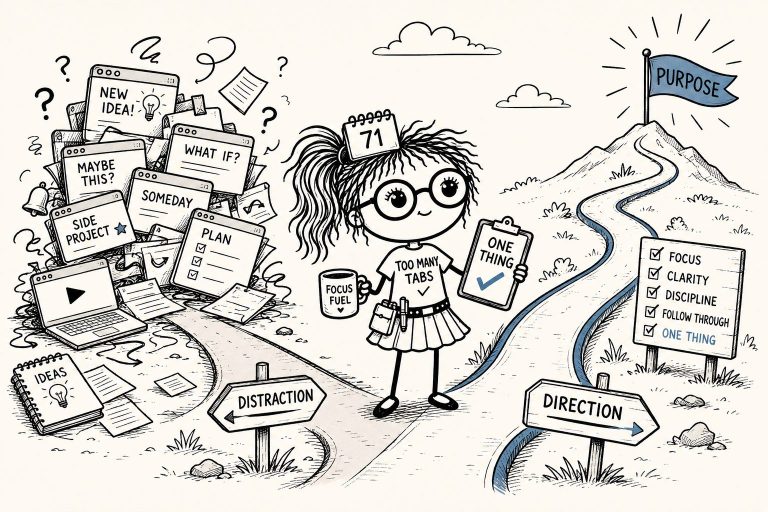
The research loop that never closes.
Smart people are genuinely good at researching. Which means the research loop is comfortable. It produces real output. Every session yields something useful. And because something useful keeps coming out, the loop never reaches a natural stopping point.
The problem is that the loop was never going to produce a decision.
Research informs decisions. It does not make them.
But if you are good at research and uncomfortable with commitment, research becomes the permanent substitute for the decision itself. You are always almost ready. Always one more article away from clarity. Always finding the next relevant thing to read before you can move in good conscience.
The intelligence is real.
The research is real.
The clarity it is supposed to produce is never coming.
Because clarity is not the endpoint of research. It is the result of deciding.
The case-building that talks you out of the right answer.
This one is particularly expensive.
You had an instinct. A clear one. The kind that arrives before your analytical mind gets involved and before the counter-arguments start filing in.
And then you thought about it.
And thought about it more.
And by the time you finished, the original instinct was buried under seventeen layers of analysis and two rounds of devil’s advocate, and you had somehow reasoned your way into a much more complicated position that is technically defensible but has nothing to do with what you actually knew twenty minutes ago.
Smart people do this constantly.
They over-analyze the instinct into noise and then wonder why they cannot hear their gut.
Their gut spoke first.
Their brain gave it a full cross-examination.
The sophistication that makes delay look like wisdom.
This is the sneakiest one.
Delay has a costume for smart people that it does not have for everyone else.
For the average person, not making a decision looks like not making a decision.
For a smart person, not making a decision looks like due diligence. Thoroughness. Responsible consideration of a complex situation. Intellectual humility. The mature recognition that this is not simple and deserves more thought before committing.
Which it might be.
But it might also just be delay.
And the smarter you are, the more convincing the delay costume becomes.
To yourself and to everyone watching.
The intelligent person who has not moved in eight months has usually constructed an airtight explanation for why that is the right approach.
That explanation will be coherent, well-reasoned, and completely wrong.
What Is Actually Happening Underneath
Strip everything back and the root is usually the same.
Self-distrust.
Not the obvious kind. Not “I don’t think I’m capable.”
The kind that looks like intellectual caution from the outside. The kind that sounds like: I want to be sure before I commit. I want to eliminate uncertainty before I put something real on the line.
Which sounds responsible.
What it actually means is: I do not trust my judgment enough to move without certainty.
The research loop is not building confidence.
It is feeding the belief that confidence must be earned through preparation rather than built through action.
That belief is the problem.
And no amount of preparation is going to fix a belief that preparation is required before moving.
The Advantage That Becomes a Trap
Here is the irony worth naming.
The skills that would serve a smart person exceptionally well on the other side of a decision, the analytical ability, the capacity to see complexity, the thoroughness, the pattern recognition, all of those become available in full once the commitment is made.
They are tools for navigating a direction.
When they are applied to the decision of whether to choose a direction at all, they become a trap.
You do not need sharp analytical skills to choose a direction.
You need to trust yourself enough to pick one.
Everything else you are good at comes into its own once you have moved.
The analysis is useful in motion.
It is paralyzing in limbo.
What Actually Interrupts the Loop
More information is not going to fix this.
You have probably suspected that for a while.
What fixes it is specific and uncomfortable.
Making a decision before your brain finishes building the opposition case.
Not before you feel ready. That is vague enough to delay indefinitely.
Before the analysis is complete. Before the counterarguments have been fully constructed. Before the third option has been explored. Before the loop produces the certainty it was never going to produce anyway.
The smart person’s version of moving before you are ready is moving before your brain talks you out of it.
That window is shorter than most people think.
The instinct arrives first. The analysis follows immediately. The longer you wait after the instinct, the more the analysis compounds, and the harder it becomes to hear what you knew before the thinking started.
The move is to act on the instinct before the full case against it has been assembled.
That is not impulsive.
That is intelligent use of your own intelligence.
One Honest Question
What have you been researching for longer than three months without a clear decision point in sight?
That is the loop.
And the loop is not going to close itself.
If This Is the Pattern Running Your Decisions
The Why You’re Still Stuck quiz shows which pattern is running your decisions.
Research loop.
Self-distrust.
Comparison.
Too many options.
Quiet fear dressed up as careful thinking.
Seven questions.
A clear read.
No new rabbit hole.
Take the quiz before your brain turns this article into another thing to analyze.
Take the quiz here.