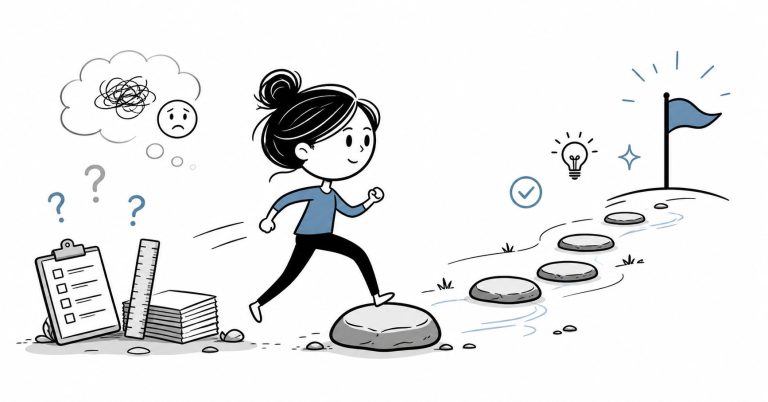

Let’s talk about what is actually happening in your head.
Not the story you tell yourself about it. The thing that is actually happening.
You have ideas. A lot of them. Career directions you have considered and not ruled out. Projects you started and did not finish. Paths you researched, got excited about, told a few people about, then quietly set aside when the timing was not right or the fear got loud or something shinier arrived.
You have kept most of them open.
Not actively. You are not sitting there every day reviewing your list of options. But they are there. In the background. Each one technically still alive, still possible, still taking up space in the part of your brain that keeps track of unfinished things.
And every one of them is costing you something.
Not because having ideas is a problem.
Because you have not closed them.
The Difference Between an Idea and an Open Decision
An idea is something you are considering.
An open decision is something you have already half-committed to in your head but never fully resolved.
That distinction matters more than most people realize.
When you start seriously thinking about a direction, whether to go back to school, whether to finally launch the thing, whether to leave the job, whether to pursue the pivot you have been circling for two years, your brain does not file it under casual interest.
Your brain files it under pending.
Pending means active.
Pending means resources are being allocated to it, even when you are not consciously thinking about it.
Pending means every time a related thought or opportunity passes by, your brain flags it and checks it against the open file.
You are not just someone with a lot of ideas.
You are someone running a lot of background processes simultaneously, and wondering why your system keeps freezing.
What Too Many Open Decisions Actually Feels Like
You probably know this feeling.
You sit down to focus on something and within ten minutes your brain has visited four other topics that have nothing to do with what you are supposed to be doing.
Not because you are distracted.
Because you have open loops, and open loops demand attention.
You try to make a decision about one thing and suddenly every other undecided thing piles into the room uninvited and starts weighing in.
You feel scattered even on days when your schedule is clear.
You feel behind even when you are technically keeping up.
You feel like you should be further along, but cannot quite identify which direction further along would even be in.
You keep researching, comparing, and reconsidering options you thought you had already put to rest.
That is not an ideas problem.
That is an open decisions problem.
And it is particularly loud for people navigating career transitions, because career decisions carry weight. They are not abstract. They affect income, identity, time, and the version of yourself you are building toward. When those decisions stay open, they do not stay quietly in the background. They hum at a frequency that interferes with everything else.
Why Capable People Accumulate Open Decisions
This is worth understanding, because the reason is not what most people assume.
It is not lack of focus.
It is not laziness.
It is not even too many interests, although that is what it looks like from the outside.
Capable people accumulate open decisions because they are smart enough to see that every real choice comes with real tradeoffs.
Choosing one direction means not choosing another.
Committing to one path means closing other paths.
Moving forward on one thing means accepting that the other things are, at minimum, deferred.
And for someone who has spent time and energy developing multiple interests, multiple skills, and a genuine sense of possibility across different areas, that closing feels like loss.
So instead of closing, you keep options open.
You stay in the research phase a little longer.
You give yourself more time to decide.
You tell yourself you just need a little more information before you are ready to commit.
And meanwhile the open decisions accumulate, each one quietly draining the mental energy that should be going toward the thing you are actually doing right now.
The Career Version of This Is Especially Expensive
Most of the open decisions that drain people have a career dimension to them.
Should I stay in this job or leave?
Should I go back to school or is that just delay dressed up as investment?
Should I pivot into this field or is that just the grass-is-greener thinking talking?
Should I build the side thing or focus on advancing where I am?
Should I take the promotion or is that a trap that locks me into a path I have been trying to exit?
These are not small questions.
They are exactly the kind of questions that deserve real thought.
But there is a point at which real thought has happened, and the decision is still open not because you need more information, but because you have not made peace with the cost of choosing.
And until you make that peace and close the decision, it stays in the pending file.
Pending.
Active.
Draining.
The average person sitting with two or three of these career decisions simultaneously is not managing them.
They are being managed by them.
Closing a Decision Is Not the Same as Making the Move
This is the part most people miss.
You do not have to have the whole plan figured out.
You do not have to be ready to execute.
You do not have to have saved the money, found the program, written the resume, or made the announcement.
Closing a decision means choosing a direction to move toward.
Not the whole journey. The direction.
Stay or go. Build or advance. Pivot or deepen.
A directional decision that is genuinely made removes the decision from the pending file. It stops the background processing. It frees up the mental space that was being used to keep the question alive.
And that freed space is not trivial.
That is the space where actual thinking happens.
Where focus lives.
Where the kind of productive momentum becomes possible that you have been trying to manufacture through more planning and more research and more preparation.
The clarity you have been looking for is often not behind more information.
It is behind fewer open decisions.
How to Start Closing Them
You do not have to close everything at once.
You just have to stop pretending that keeping everything open is neutral.
Start with the one that has been open the longest.
The career question that keeps returning. The pivot you keep circling. The decision you made in theory years ago and keep reopening in practice.
Ask honestly: do I actually need more information to close this, or do I need to make peace with the cost of choosing?
If you need more information, identify specifically what that information is and how you would get it. Not more general research. Specific information. One conversation. One application. One test.
If you need to make peace with the cost, name the cost. Write it down. Not dramatically. Plainly. What are you actually giving up by choosing this direction?
Most of the time the cost, when named specifically and honestly, is more manageable than the vague weight of the open decision that has been running in the background for months.
The One Tab Worth Keeping Open
Your brain has 71 tabs open.
Your life only needs one next step.
Not the whole plan. Not every question answered. Not every risk eliminated.
One direction, chosen honestly, and the first real step toward it.
That is what clears the noise.
That is what produces the focus you have been trying to find through more information and more preparation.
And for most people reading this, that one tab is not a mystery.
It has been there for a while.
You just have not closed the other seventy yet.
If Your Biggest Open Decision Is a Career One
The most draining open decision most people carry is a career decision.
Stay. Quit. Pivot.
Three options, and the wrong diagnosis leads to the wrong move.
The Stay Quit Pivot Filter is a free five-question tool built to help you sort out which of those three is actually the right next move for your specific situation. Not in theory. Based on what is actually happening in your work life right now.
It does not make the decision for you.
It helps you get honest about what is driving the indecision, what still has value, and what the most logical next step actually is.
Get the free Stay Quit Pivot Filter here.
About 20 minutes.
One less open decision by the end of it.
That is worth the time.