Because owning your story beats defending your excuses every time.
Nobody likes feeling lazy — so we dress it up with logic.
Some people have turned avoiding effort into an art form.
You’ve probably heard it (or said it):
“I’ll go to the gym tomorrow when I’m more rested.”
“I was going to wake up early, but I needed to listen to my body.”
“It’s raining — probably a sign from the universe to rest.”
We don’t call it laziness. We call it self-care.
But deep down, we know what’s really happening — we’re protecting comfort, not growth.
And the more intelligent or self-aware we are, the more believable our excuses sound.
We convince ourselves that the timing, the mood, or the circumstances just aren’t “right.”
That’s how we end up stuck — doing mental gymnastics instead of push-ups.
Let’s take a humorous look at this through two characters: Bart, the master of excuses, and Abs, his no-nonsense friend.
Bart’s Guide to Excuses: How to Avoid the Gym (and Accountability)
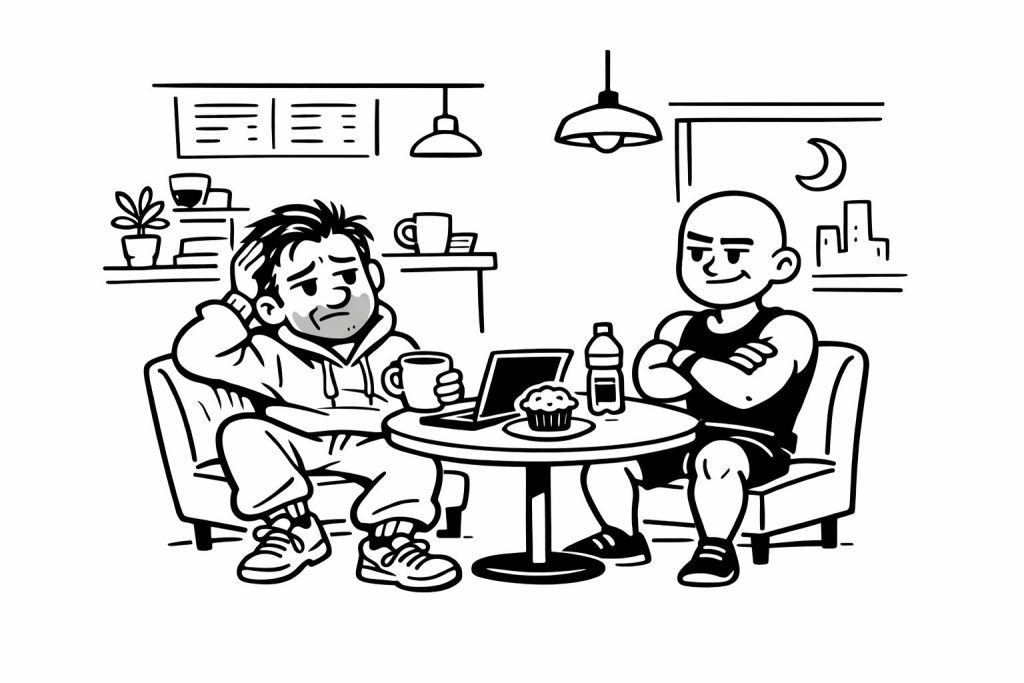
Scene: Coffee shop, 6:00 PM. Bart’s in sweatpants — strictly for comfort, not cardio.
Abs:
So, we hitting the gym today or just continuing your record-breaking streak of almost going?
Bart:
I was gonna go, but I’ve had this pounding headache all day. Probably dehydration… or my body warning me not to push it. You know — health first.
Abs:
Right. Because nothing says health first like skipping leg day for the 57th consecutive time.
Bart:
Also, the gym’s too crowded right now. I’ll go later when it clears out.
Abs:
It’s literally half empty.
Bart:
Yeah, but that’s when the late crowd comes in. And by then, it’ll be too late. Gotta get my eight hours — recovery is key.
Abs:
Recovery from what, exactly?
Bart:
From life, Abs. It’s been a long week.
Abs:
It’s Tuesday.
Bart:
Exactly.
(Cue more excuses: “It was raining,” “I’m still sore from two weeks ago,” and the ever-wise, “I don’t want to overextend myself. I read that can cause problems.”)
Sound familiar?
The Psychology Behind the Excuse Factory
According to research from the Journal of Personality and Social Psychology (Baumeister et al., 1998), people make excuses not just to deceive others, but to protect their own self-image.
It’s a defense mechanism that helps us maintain our sense of moral integrity.
In simple terms: your brain hates feeling wrong.
So, it rewrites the story to protect your ego.
The problem? Over time, those excuses turn into a habit — and that habit kills growth.
The more we justify our choices, the less we challenge them.
Even the smartest people fall into this trap.
They rationalize instead of reflecting.
If This Sounds Like You…
The good news is that accountability is a skill — one you can build.
Here’s how to start:
- Catch your “buts.”
Every “I was going to, but…” is a red flag. Replace it with:
→ “I didn’t, because I chose not to.”
That small shift removes the fog and brings truth into focus. - Ask what’s really behind the excuse.
Fear? Laziness? Insecurity? You can’t fix what you won’t face. - Get comfortable with discomfort.
Growth lives there. Each time you avoid a hard thing, you strengthen the wrong muscle — avoidance. - Own your mistakes fast.
Whether it’s missing the gym, snapping at someone, or procrastinating — apologize, learn, move on.
Accountability is emotional fitness.
If This Sounds Like Someone You Know…
You can’t force accountability into someone else — but you can model it.
Here’s how to deal with a chronic excuse-maker (without losing your sanity):
- Lead by example. Let them see you owning your mistakes calmly and confidently.
- Be curious, not confrontational. Ask, “What’s really stopping you?” instead of “Why do you always make excuses?”
- Set clear boundaries. Especially with bosses, coworkers, or partners who refuse feedback. Protect your peace.
Responsibility is contagious — but so is blame. Choose wisely.
Final Thought
Excuses feel good in the moment — they protect your pride.
But they also protect your stagnation.
When you take responsibility — even for small things — you reclaim your power.
You grow. You mature. You evolve.
Whether it’s showing up to the gym, starting that project, or having the tough conversation, your life starts moving forward the moment you stop defending your excuses and start owning your story.
Even if that story starts with, “I’ve been a little like Bart.”
You cannot solve what you have not named.
Why You’re Still Stuck (It’s Not What You Think)
7 questions. Uncomfortably accurate. This is not a personality quiz. It is a diagnosis.
TAKE THE QUIZ →